


coot
(pronunciation: the letter ‘c’ is said with a ‘k’ sound, as in “king”, and the letters ‘oot’ rhymes with the ‘oot’ in “boot” — for the right pronunciation of this word, please click here)
 a kind of water bird – related to ‘rails’ and ‘moorhen’ – medium-sized, usually black feathers, short round wings, short legs; cone-shaped beak (bill) and a shield (mark) of white or red or other lighter colours on the forehead from the beak to the crown; on average, 18 inches in length and about 1 Kg. in weight; feeds on water plants, small animals and eggs; lives for about 9-10 years (and some can live up to 18 years but rare); about 10 species, originally from South America, now common in Europe and North America,
female ~~ hen
baby ~~ chick
group ~~ flock (general word); covert & cover (in the USA);
{other words used for a group of coots are (?): codgery, commotion, fleet, shoal, swarm}
Voice (call) ~~ cackle, cluck, croack (sounds like ‘kak’, ‘crek’, ‘poonk’, ‘click’ depending on the purpose of calling)
Though they can swim well like a duck, their feet are not webbed (toes joined by a thin layer of skin) like that of a duck. Coots have long lobed toes on each foot which help them to walk on uneven muddy ground and also swim in water. Coots like to steal food from other birds, rather than hunt or find for themselves! coot (noun) = (a) a fool (b) a person with an odd behaviour (eccentric), usually an old man 2. as bald as a coot 3. as bare/black as a coot 4. as crazy/queer/lousy as a coot 5. as poor/stupid as a coot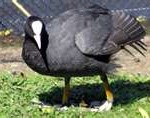 Eurasian coots have a distinct patch on their forehead, which is nothing but a featherless spot; the American coots, however, have a feathery red spot. Some experts think that the phrase ‘as bald as a coot’ may have been coined from this featherless spot on the Eurasian coots.
 They are also called ‘marsh hen’ or ‘mud hen’ because they bob their heads while walking and swimming like the ‘moor hen’. (‘bob’ = to move up and down)
1.
More from Animals in Language
Python
python: a large python a kind of snake -- reptile -- usually large, muscular and powerful -- grows to 1 metre …

Animals-Adder-Aye-Aye
A B C D E F G H I J K L M N O P Q R S T …