


eagle
[For the right pronunciation, please click here.]
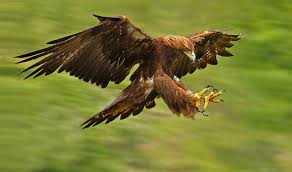
a golden eagle
a kind of bird – bird of prey – rather large with heavy head and sharp powerful hooked beak (bill); strong legs with sharp powerful talons (like nails on people’s fingers); commonly gray or brown feathers, but different kinds with different colours; keen (very good) eye-sight; different species different sizes – from 1 foot to 3 feet, and weighs – from 250 grams to 9 Kg.; females larger than males; feeds on (eats) hares, rabbits, squirrels, snakes, frogs, lizards, fish, other small birds, and even (the larger kinds) lambs and small goats and deer; about 60 species (kinds) found all over the world, except Antarctica
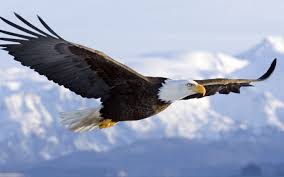
an eagle in flight
female ~~ hen / hen-eagle / eagles
baby ~~ (chick) eaglet / fledgling
group ~~ aerie / convocation
voice (call) ~~ scream
home ~~ (nest) eyry / eyrie / aery (for laying eggs and raising eaglets)
movement ~~ swoop (in flight – some species)

talons/claws
Eagles are of four categories:
sea/fish eagles, live near water and feed on fish;
giant forest eagles, live in forests and hunt small animals;
booted/true eagles, have feathers right up to their ankles,
and snake/serpent eagles, feed mostly on snakes.
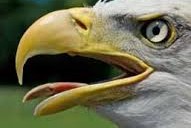
strong beak/bill
The ‘eagle’ is the national bird of Albania, Armenia, Nigeria, Serbia, Moldova;
the ‘steppe eagle’ is the national bird of Egypt;
the ‘golden eagle’ — Mexico, Austria, Germany, Kazakhstan;
the ‘bald eagle’ — the USA;
the ‘Javan hawk eagle’ – Indonesia;
the ‘Philippine eagle’ – Philippine;
The ‘eastern imperial eagle’ – Iraq;
the ‘white-tailed eagle’ – Romania;
the ‘Harpy eagle’ – Panama;
the ‘African fish-eagle’ – Zambia & Zimbabwe.

a crested eagle
Eagles are said to be the “Masters of the Sky”. Every part of their body is designed to meet the requirements of a formidable hunter: sharp hooked beak (bill); strong legs and sharp powerful talons; very good eye-sight; and large powerful wings – some kinds have a wingspan of 7 feet wide!
However, not all eagles are large: the ‘crested serpent eagle’ is just as small as a pigeon!
The largest, of course, are the ‘Harpy eagle’ and the ‘Philippine eagle’.
The ‘African vulturine fish-eagle’ is a vegetarian, feeds more on oil palm fruit than meat!
The eagles are so graceful in flight and so majestic to look at that they are held in great respect all through the history of mankind.
They are the national animals of several countries and found on the coat-of-arms of several ancient and modern armies; the emblems of different nations and organisations.
The feathers of large eagles have been used for decorating the head-dresses of the chiefs and the war-lords in many tribal societies.
These ‘masters of the sky’ are found not only in the ancient religious and social scriptures but also in many fables, story books of the recent times!!
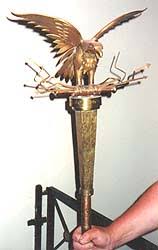
eagle on Roman standard
1. eagle (noun) =
(a) the military standard of the Roman Empire
(b) the national emblem of the US
(c) a gold coin worth of ten dollars with an eagle on one side, formerly used in the US
(d) a score of two strokes in the game of golf
2. to eagle (verb) = to score two points in the game of golf

eagle in US emblem
3. eagle-eyed [said of a person with keen sight and who notices everything]
4. to scream like a wounded eagle = to make a loud protest, fuss, etc.
5. (a) the day the eagle screams
(b) the day the eagle shits [said of the payday, when the workers or employees get their wages or salaries]
6. the eagle does not catch flies [said to mean that someone’s opponent is not equal, below regard]
7. eagles fly alone; sheep flock together [said to mean that quality is likely to be lonely, seen clearly]
8. you cannot fly like an eagle with the wings of a wren [a piece of advice to anyone whose ambitions are beyond their ability] (‘wren’ = a small bird)
More from Animals in Language
Python
python: a large python a kind of snake -- reptile -- usually large, muscular and powerful -- grows to 1 metre …

Animals-Adder-Aye-Aye
A B C D E F G H I J K L M N O P Q R S T …