


elephant
(plural: ‘elephants‘; for the right pronunciation, please click here)
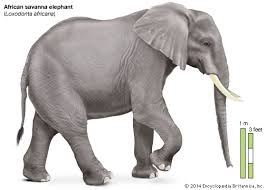 a kind of animal – mammal – large four-legged, grass-eating animal with large head and ears, small eyes, a long nose called ‘trunk’, large round body with little hair, round pillar-like legs, relatively short tail; grows to 10-13 feet tall at the shoulder and weighs 3,000-12,000 Kg.; feeds on (eats) grasses, leaves and barks of trees; mostly reddish brown or gray in colour; lives for 70 years; two main kinds – African and Asian – found on the plains and in the forests of Africa and Asian countries, including Sri Lanka, Indonesia, Thailand, Borneo and Sumatra,
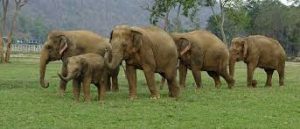
a small herd of elephants
female ~~ cow
baby ~~ calf
group ~~ herd, parade
voice (call) ~~ trumpet/bellow/roar
movement ~~ amble
The ‘elephant’ is the national animals of Côte d’Ivoire (Ivory Cost), Kenya and South Africa of the African continent.
The ‘Indian elephant’ is the national animal of India, sharing the title with the ‘Bengal tiger’. (?)
The ‘Thai elephant’ is the national animal of Thailand, Asia.
The elephant is the symbol of the Republican Party (political) of the USA.
The elephant is the largest of all the land animals. It is one of the‘pachyderms’ (= thick skinned animals – like rhinoceros, hippopotamus, etc.).
The ‘Borneo pygmy elephant’ is the smallest and the ‘African elephant’ is the largest of all elephants.
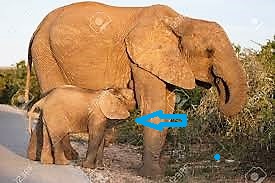
a calf suckling (teats in the front)
The female elephant has its mammary glands (teats) in the front, right behind the forelimbs (front legs). The other four-legged mammals, with the exception of monkeys, have these glands at the back, between the hind (back) legs.
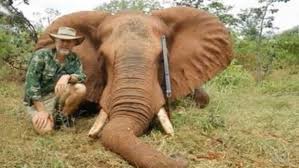
a large head and larger ears
Every part of an elephant is unique:
head: large head to contain a brain weighing 5 Kg. which gives the elephant intelligence, good memory, etc.
ears: large ears to cool the blood when it passes under the thin layer of skin of the ears when the elephant flaps them.

multipurpose trunk
trunk: the most amazing feature of the elephant is the trunk – the nose and the upper lip are fused to form this long “proboscis”, called ‘trunk’ – it is like an arm, extra foot, and the nose for the elephant; it is strong and flexible, made of 100, 000 muscle cells; the elephant can reach branches of trees some 24 feet high with it, and can break them easily; though the elephant does not drink (suck) water straight away with the trunk, as most people believe, it sucks the water with the trunk, but pours it into its mouth for drinking, and sprays on its body while bathing; with the help a finger like growth on the tip of this trunk – one finger in Asian elephant and two fingers in African elephant – the elephant can pick a small blade of grass; with the trunk raised high, an elephant can smell water located some distance away and the predators hiding behind bushes or trees, and can listen to the sounds that are not audible to other animals, including humans!
As the human children must learn how to use a straw to sip drinks from a bottle, the baby elephants (calves) must learn to use their peculiar nose!
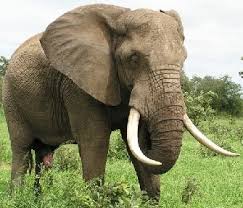
tusks
tusks: the tusks are the upper teeth, grown to 6-10 feet long, sticking out on either side of the trunk; these tusks are used for digging the ground for water, peeling the trees of the bark, and fighting with other elephants, and to rest its large trunk now and then! Unfortunately, this useful tool for the elephant is also the main reason for the elephants being hunted by people; these tusks

expensive decorative articles from tusks
are made of a substance called ‘ivory’ which is smooth, shiny and durable; people make small to medium-size statues and figures with this ivory, which are in great demand in the open market in olden days and on the black market these days!
Both the male and the female African elephants have tusks, but only the males have full tusks in Asian elephants. The Asian female elephants, however, have “tushes”, very short tusks that just stick out beyond the upper lip.
legs: the four legs are like four strong round pillars; though they look hard and difficult to fold, they are very supple; the soft cushion-like pads on their feet make it possible for the elephant to walk so softly that hunters

elephant’s dung
never hear a herd of elephants passing until the herd suddenly comes up on them; the legs are like ears, too! Elephants can receive sounds in the form of vibrations from the ground or directly from the air; the legs are so strong that a 12,000 Kg. elephant can walk miles on end to get to water, or can even sleep standing up!
dung: the dried dung (shit) of an elephant is used as a fuel in the domestic fires, and the smoke when burnt is used as a mosquito repellent (= the medicine used to drive away insects) without any side effects!
All the elephants in a herd are, largely, closely related females – mothers, sisters, aunts and calves of both sexes, and is controlled by one senior – large and old – female elephant called ‘matriarch’. Babies are looked after by the whole herd.
The males join the herd during the mating season, and then leave the herd to live on their own.
Elephants love water and can swim well; they can be under water for long periods of time with the trunk kept above the water to breath, like ‘snorkelling’.
Elephants are known to show emotions – cry, feel sad and even laugh! They are known to mourn the loss of their relatives. It has been observed that when one elephant is need of help, all the other elephants show eagerness to help, by making reassuring sounds, by touching the distressed one with their trunks, etc.!
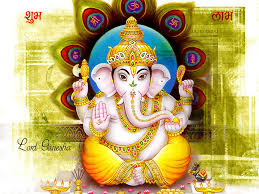
Lord Ganesh, the elephant-headed deity
The Elephant appeared in ancient cultures across the world. It is the symbol of wisdom in Asian cultures. In Hinduism, one of the most important deities, Lord Ganesh – the ‘Lord of beginnings’, ‘remover of obstacles’, ‘patron of arts and science’, ‘symbol of wisdom’, and ‘chief of the armies of the gods’ – is adorned with the head of an elephant!!
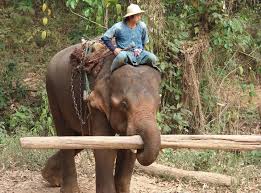
beast of burden
Elephants were used in the wars of yesteryears along with the horses and camels; and have been used, particularly in Asia, as ‘beast of burden’, hauling heavy logs of timber, and

USA Republican Party Logo
large slabs of stone!
They are a special attraction in circuses and zoos.
The elephant has been the mascot of several international sports meets, and is found in the logos of numerous organisations!!
More from Animals in Language
Python
python: a large python a kind of snake -- reptile -- usually large, muscular and powerful -- grows to 1 metre …
Animals-Adder-Aye-Aye
A B C D E F G H I J K L M N O P Q R S T …