


emu
[For the right pronunciation, please click here.]

a kind of bird – flightless bird – belongs to ratites — large with long neck and legs; very short wings never used for flying; three toes on each foot; grows to 3-4 feet at the shoulder (total height 6 feet) and weighs 30-60 Kg.; females larger than males; shaggy and drooping brown or gray-brown feathers; feeds on (eats) plants and insects; lives for 10-20 (30) years; originally from Australia, but now found on farms in most parts of the world,
female ~~ female/femus (?)
baby ~~ chick, hatchling
group ~~ mob
voice (call) ~~ boom, drum, grunt
Emus are the second largest flightless birds in the world. {the ‘ostrich’ being the largest flightless bird}
The emus cannot fly but they can walk or run (trot) great distances using their strong, powerful legs. However, they cannot walk backwards!
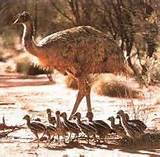
After mating with a male, the female emu lays the eggs in a nest built by the male and leaves the nest to mate with another male and to lay another clutch of eggs! The male, however, stays with the eggs without eating or drinking or even leaving the nest, for almost 8 months, turning the eggs over ten times a day until the eggs hatch! Even after the eggs hatch, the male stays with the brood of chicks, teaching each of the chicks how to eat and defend itself!
The ‘emu oil’ has been used for joint pains, burns, etc., for thousands of years by the Australian aborigines (the native people of Australia). Besides the oil, most parts of the emu – meat, eggs, feathers, hide (dried skin), and even egg shells – have potential market and can earn good money!
emu (noun) =
(a) ground staff to the air-men (air force – Australian usage)
(b) any of various systems of units measuring electricity and magnetism
(c) European Monetary Union (usually in capital letters)
(d) Economic and Monetary Union (usually in capital letters)
More from Animals in Language
Python
python: a large python a kind of snake -- reptile -- usually large, muscular and powerful -- grows to 1 metre …

Animals-Adder-Aye-Aye
A B C D E F G H I J K L M N O P Q R S T …