


flamingo
(plural: ‘flamingos‘ or ‘flamingoes‘ — for the right pronunciation of this word, please, click here)
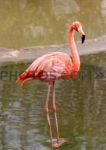
a lone flamingo
a kind of bird — water bird/wading bird — large bird with thin long legs with webbed-feet and long curved neck, round head with a peculiar shaped beak (bill) that is bent down, looking as if it were broken, with a large, fleshy tongue covered with bristle-like projections that help filter water and food particles through, eyes yellow in adults and brown in chicks, relatively short tail with 12 to 16 feathers, mostly with pink or reddish feathers; size: the largest (greater flamingo) about 5 feet tall and the smallest (lesser flamingo) about 1 to 2 feet tall, weight: depending on the species (kind) anywhere from 2 to 4 Kgs. (The Chilean flamingo is known to weigh more, up to 6-8 Kg.), males larger than females; feeds on algae, small insects, lobsters, crabs, shellfish, snails, and small fish; (no authentic study on longevity has been made so far) lives for 20 to 50 years (some say even 80 years); found near the shores and shallow waters of ponds, lakes and swamps of parts of South America, parts of Africa, Asia, and Southern Europe,

a flamingo in flight
female ~~ female
baby ~~ chick
group ~~ (adults) colony, pat, flurry, stand, flamboyance, regiment, skein; (chicks) crèche
voice ~~ honk (similar to that of a goose)
home ~~ nest (for a female to lay eggs)
The Greater Flamingo is the state bird of Gujarat, India.
The most striking feature of a flamingo is the colour which in most flamingos is pink, and in some reddish brown. This colouration, according to the ornithologists, is due to the pigment in the food they eat.

long necks
Flamingos have long necks with 19 neck bones that help the birds to move their head easily.
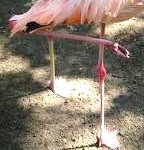
The legs of adult flamingos are longer than their bodies, measuring between 80 to 125 cm (31.5-49 in.), depending on the species. The ankle is located about halfway up the leg, the knee is located close to the body and is not externally visible. Flamingos stand on one leg with the other tucked beneath the body. Andean Flamingos have yellow legs and feet!
The beak (bill) of a flamingo is suited well for filter feeding. The upper beak bone (mandible) is thin and flat, and functions like a lid to the lower beak bone which is large and trough shaped. Rows of hair-like structures (lamellae) help the flamingo filter the water for food.
And while filtering for food, the flamingo is known to turn its head upside down and move its head from side to side so that more mud and water get into its beak!

strange beak/bill
The tongue is another special feature found in flamingos. It is covered with hair-like growth help the flamingo filter the water. Scientists have observed that the tongue is used as a powerful piston that sends out water through the beak while the filtering process is in progress.

feeding crop milk to a chick
It is very interesting to know that flamingos do not feed their chicks with small insects or vomit out the food they have eaten before, the way most other birds do. They produce a kind of thick (semi-solid) milk-like substance from their crop (the loose neck part close to the beak) and along the beak. And add to this strange feeding habit, the ‘milk’ is red in colour and both males and females produce it and share the chore of feeding the chick!
More from Animals in Language
Python
python: a large python a kind of snake -- reptile -- usually large, muscular and powerful -- grows to 1 metre …
Animals-Adder-Aye-Aye
A B C D E F G H I J K L M N O P Q R S T …