


fly
(plural – ‘flies‘ — for the right pronunciation of fly, please click here)
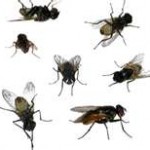
house flies
a kind of insect – with three parts of the body – head, thorax and abdomen, and three pairs of legs, but with only one pair of wings; grows to ¼ to ½ an inch; feeds mostly on(eats) the plant sap and nectar; lives for about 2 months; found all over the world,
female ~~ female
baby ~~ maggot
group ~~ swarm, cloud, business
sound (not voice) ~~ buzz, hum
Most of the 90,000 species of flies are a nuisance to people.
The most common and notorious of all ‘true flies’ is the ‘house fly’ which is the carrier of diseases, such as typhoid fever, cholera, dysentery and anthrax.
Flies cannot bite, but carry the disease causing germs on the hair on their legs, and in their saliva which they use to make their food material soft.
When a fly settles on a dirty place or some rotten thing, the germs attach themselves to the flies, and then when the same fly settles on something clean – another animal or person, and starts to rub its legs to keep them clean, the germs drop off on that place, animal or person, thus transmitting the diseases.
Most of the species can taste things with their mouth parts and feet as well.
Flies have been used to represent death – mentioned often in the ancient and modern scriptures!
For an interesting article about lanternflies, please click here.
More from Animals in Language
Python
python: a large python a kind of snake -- reptile -- usually large, muscular and powerful -- grows to 1 metre …

Animals-Adder-Aye-Aye
A B C D E F G H I J K L M N O P Q R S T …