

fuller:
a worker whose job is to clean and thicken the newly made (woven) cloth,
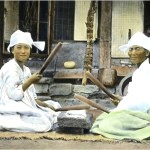
two Korean fullers fulling the cloth by ponding it with wooden sticks (1900) — the cloth was placed on a slab of stone between them
In the very past, the job of a fuller was described as the worst of all times.
To soften the fibre, the fullers in the past used ‘fuller’s earth’, a kind of clay found in the nature, and a week old urine!
In the modern day cloth making, fullers, the workers who did the fulling of cloth in the past, are not needed, but the good old ‘fuller’s earth’, a type of clay, is still used.
Some experts compare the fullers of the past to the ‘dry cleaners’ of the present, both cleaning cloth using tools and chemicals!
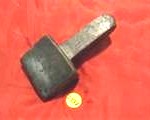
(a fuller — a blacksmith’s hammer/tool)
Note 2: ‘Fuller’ is more commonly used as the comparative form of the adjective word ‘full’ — full — fuller — fullest, to mean ‘complete’, ‘up to the top or brim of something’, and also it is used as a noun referring to a thing/tool. For an article that shows us how this word is used as an adjective in comparative form, please click here.
Note 3: ‘Fuller’, always with a capital ‘F’, is often found in the names of people, e.g. Kip Fuller, Tia Fuller, Ben Fuller, etc. For an article that explains the probable origin, please click here.