


guinea fowl
(also called ‘guinea hen’; pronunciation – the letter ‘g’ rhymes with the letter ‘g’ in “gun”, and the end pronunciation is ‘ni’, not ‘nia’ – roughly ‘gi-ni’ — for the right pronunciation, please click here)
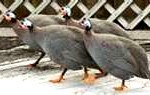
four guinea fowl
a kind of bird – ground bird – related to pheasants and turkeys – medium-sized with plump body, with white spots on mostly grey feathers (speckled) with small white spots, with little hair on head, almost bare; short strong conical beak (bill), with short or long wattles (growing to ¾ of inch); head crests or helmets (in some kinds); short tail with drooping feathers; grows to 20-24 inches long, and weighs 1-2 Kg.; males larger than females; feeds on (eats) seeds, grain, leaves and insects and other small crawling animals, such as lizards, worms, etc.; lives for 10-15 years; 7 species found originally in Africa, but now grown on farms in Europe, the Americas and Asia
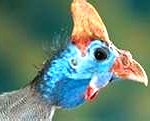
helmeted guinea fowl
female ~~ hen
baby ~~ keet
group ~~ flock
voice (call) ~~ screeching, creaking metallic sounds (several other sounds – no particular name) (males – one note, like ‘creek’; females two notes, like ‘creek’…’creek’)
home ~~ nest (shallow dip in the ground near the base of a tree, in the wild) coop (man-made)
The meat of the ‘guinea fowl’ is also called ‘guinea fowl’ or ‘guinea squab’.

red wattles under the beak/bill
Guinea fowl are named after “Gulf of Guinea in western Africa” where they were found in plenty in olden days, or probably that was the place where the first Europeans saw them.
Guinea fowl are one of the main food sources in some parts of the world, including Europe. They are grown on farms for their eggs, meat and feathers. They are also considered ‘game bird’ which means people hunt them, rather shoot them, for sport.
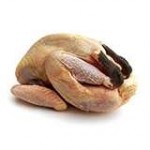
guinea fowl eaten as food
Guinea fowl are said to be easy to rear because they can live on whatever is available, and they are believed to be sturdier than the common chicken.
They can go without water for long periods of time.
Several farmers prefer to keep some guinea fowl with their chicken, for guinea fowl are known to be on the watch, and make different loud calls when any strangers, stray dogs or cats get near their ‘living quarters’!
More from Animals in Language
Python
python: a large python a kind of snake -- reptile -- usually large, muscular and powerful -- grows to 1 metre …

Animals-Adder-Aye-Aye
A B C D E F G H I J K L M N O P Q R S T …