


horse
[For the right pronunciation, please click here.]

a horse
a kind of animal – mammal – four-legged, grass-eating – large and sturdy, with short smooth coat (hair) in different colours, large head with relatively long muzzle (= mouth and nose part), with strong broad jaws, clear eyes, short straight ears, long strong neck with long soft hair on the back (called ‘mane’), wide muscular chest, and muscular shoulders and rump (the top of back leg, like thighs), slim strong legs with a single hoof on each foot, long bushy tail; size: {depends on the breed} but on average, 5-6 feet tall at the shoulder, (some breeds are as small as 1½ feet tall and weigh only 24 Kg.), and weighs 350-900 Kg.; feeds on (eats) grasses in the wild, and grasses, hay (=dry grass), grains, such as oats, in domestication; lives for 25-40 years (some individuals can live up to 60 years); only one wild species (kind) and only one domesticated species with about 350 breeds, bred in many parts of the world
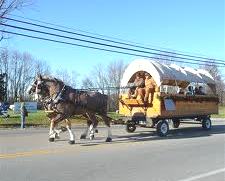
pulling a wagon
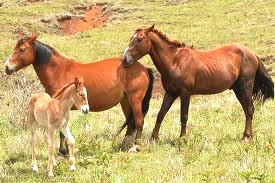
a mare & stallion with a foal
female ~~ mare; [‘dam’ when referring to as the mother of another horse]
baby ~~ foal; [‘colt’ a male foal; ‘filly’ a female foal]; [yearling – between one and two years]
group ~~ herd; [‘stud’ kept on a farm for breeding purpose]; [‘pair’ & ‘team’ when put to work, to plough or to pull carriages, etc.]; mob; troop; field; harras
voice (call) ~~ neigh, whinny
home ~~ stable (in general – man-made); corral (western American usage); stud farm (where horses are kept for breeding purpose); paddock (a fenced enclosure near a stable or at a race course for horses)
movement ~~ walk, trot, canter, (prance), gallop
The ‘Canadian horse’ is the national animal of Canada.
‘Horse’ as the state animal of certain states in the United States of America:
Morgan horse – Massachusetts; Vermont; Thorough bred horse – Maryland & Kentucky; Appaloosa – Idaho; Racing horse – Alabama; horse – New Jersey; Nokota horse – North Dakota; Missouri Fox Trotting horse – Missouri; Tennessee Walking horse – Tennessee

Prezwalski’s horse — only true wild horse species in the present world
There is only one wild horse species, Przewalski’s horse (pronunciation: “shee.valh.skee”), found in the wild, but, ironically, even this horse is found only in captivity, i.e. in zoos or private gardens! And the rest of the horses that people have been familiar with are all the breeds of one domesticated horse species.
Horses have the largest eyes of any land animal!
Horses have been in relationship with people for centuries; people domesticated the horse somewhere about 4,500 BC.
Horses have been used in wars

an ancient war chariot
(pulling chariots; in cavalry = soldiers on horses),
in agriculture (ploughing/plowing fields, pulling carts, etc.),
as ‘beast of burden’ (carrying loads, pulling carriages), as a means of transport, in sports and entertainment (in horse races, in games like polo, in circuses doing feats), as pets, and in police work

the police on horses at a riot/protest
(horse ‘mounted police’ are used in keeping mobs of people off the streets or under control in disturbed areas and times)!!
Horses have been kept on farms for their meat, milk, hide (= dried skin to be made into leather), hair (in making brushes and ropes), bone, and the urine of pregnant horses is used in making medicine!! {… wondering what that medicine could be!?}
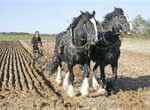
horses ploughing/plowing fields
As in many other animals, the sizes in horses vary very widely: the dwarf miniature horses are smaller than a common dog; and the large breeds, draught horses, like the Belgian or Shire, are 6 feet tall at the shoulder and 900 Kg. in weight!
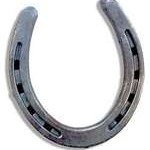
a horse-shoe
A horse shoe is a strip of metal in the shape of a ‘U’ put on the bottom of a hoof of a horse to protect the hoof. In some places the horse shoe is kept for good luck, but in some other places a horse shoe turned upside down is considered bad luck!
The horse has been in several scriptures, epochs, stories, fables, comics, cartoons, radio & TV shows and in motion pictures (films)!!
More from Animals in Language
Python
python: a large python a kind of snake -- reptile -- usually large, muscular and powerful -- grows to 1 metre …

Animals-Adder-Aye-Aye
A B C D E F G H I J K L M N O P Q R S T …