


jellyfish
(also known as ‘jelly – plural – ‘jellies’ – or ‘sea jelly’ {in America}; ‘medusa’ – plural – ‘medusae’ {semi-scientific name} — for the right pronunciation, please click here)

a jelllyfish
a kind of sea creature (animal) – related to corals
Though it has ‘fish’ in its name, a ‘jellyfish’ is not a fish.
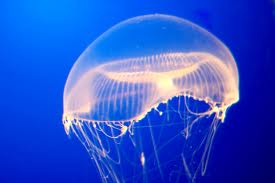
a jellyfish — no bones
A Jellyfish has no bones, no head, no eyes or ears, no brains, no heart, no arms or legs; it has just an umbrella- or cup-shaped body called ‘bell’, usually transparent, thin membrane, and some tentacles (= long thin thread-like organs) with stings, and just a mouth and stomach, and some nerve cells!
There are about 2,000 species of jellyfish; and found in all the oceans, and a few species (kinds) are found in fresh water.
Jellyfish vary greatly in size and weight: from just ¼ of inch to 8 feet in diameter of the ‘bell’ (body), and from one eighth of inch to 200 feet long tentacles.
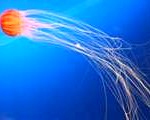
long tentacles
Some species of jellyfish weigh just a few milligrams, but some can weigh 250Kg; but of the total weight, 96% is water!
Some species of jellyfish live only a few hours, but some other species live up to 30 years. Some coastal jellyfish live for 2-6 months. The lifespan of a jellyfish is in proportion to the availability of food, and other water related factors.
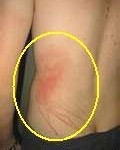
jellyfish sting
Jellyfish feed on zooplankton (= tiny floating animals), shrimps, fish, and other species (kinds) of jellyfish. They grab or surround the prey (= animal they kill and eat) with their tentacles, sting them with mild poison through their stings to paralyse the prey, and then take them in through their mouth opening.
Some jellyfish release eggs and sperm into the water, and the free-floating eggs fertilise in water.
The tentacles of a jellyfish are equipped with ‘stings’ which attach themselves to anything that comes in contact with them, including humans.
The sting is known to be very painful, and the poison (toxic fluid) paralyses small living things; but the stings of some species are known to be very fatal, even to humans! The ‘sea nettle’, ‘box jelly’ (also known as ‘sea wasp’(?)), and the tiny 2cm ‘Irukandji jelly’ stings are believed to be the most poisonous stings of all, they can even kill a person!!
Most jellyfish are transparent, but there are some jellyfish that are ‘phosphorescent’, i.e. they glow in the dark.

jellyfish as food
The sudden appearance of thousands of jellyfish at a place and at the same time is called a ‘bloom’.
There are no ‘male’ and ‘female’ jellyfish; one parent jellyfish has both the characteristics in it – of a male and a female (?). However, the baby jellyfish is called ‘ephyna’!
Jellyfish are drifters, i.e. they just float on the currents or movements of the water, but there are some species which move by propulsion, i.e. by drawing in water into the ‘bell’, the body, and then expelling the water and moving in the opposite direction of the expelled water!
Jellyfish are an important food source in several parts of the world; and they are also a popular aquarium or fish-tank pets!
1.
jellyfish (noun) = a person without any moral strength and courage
2.
as spineless as a jellyfish (‘spineless’ = without any courage; not brave)
3.
as soft as a jellyfish
4.
as little uproar as a jellyfish
More from Animals in Language
Python
python: a large python a kind of snake -- reptile -- usually large, muscular and powerful -- grows to 1 metre …
Animals-Adder-Aye-Aye
A B C D E F G H I J K L M N O P Q R S T …