


justice:
(plural: ‘justices‘, mostly used as an uncountable noun; for the right pronunciation, please click here)
a judge and a part of the title of a judge of a court of law,
(short for) Justice of the Peace,
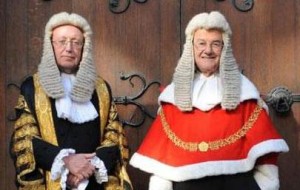
Justices in UK
e.g.
Justice Adam White is the presiding judge in today’s court.
Some people consider using ‘justice’ in place of ‘judge’ more respectable; for instance, ‘Judge Carlson’ is lower in position and power than ‘Justice Carlson’.
The acting judges in a country’s Supreme Court are usually called ‘justices’: ‘Justice Benson’, ‘Chief Justice Matilda’, etc.
Justices of the supreme court are either elected or nominated depending on the judiciary system of the country, and being justices in supreme court is a life ambition of almost every judge!
For an article on the difference between a justice and a judge, please click here, for an informative article on the role of a chief justice in the USA, please click here, for a news item about the first female justice in Philippines, please click here, for a news article that shows how we read of ‘corrupt’ justices in our daily news, please click here.
Compare: judge
“Justice” is also used to refer to the principles of morals, good reason, and the quality of being right according to the law of the land and the morals of the society, e.g. “When her attacker was sentenced to two years in prison, she felt that justice had been done.”; for a news article, with a video clip, in which we see this word being used in this context, please click here, and ‘justice’ is also used in situations where there is no involvement of crime or criminals to mean ‘to do the right thing’, for example: “You will not do justice to your talent if you do not take part in serious competitions.”
Return to “judge“.