


monkey
(plural: ‘monkeys‘; for the right pronunciation, please click here)
a kind of animal – mammal – four-legged – plant and meat eating – lives mostly in trees (some live on land) very active during day –
There are two types of monkeys:
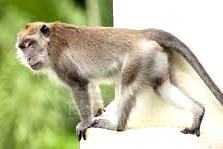
Old World Monkeys – found in Africa, Asia;
New world Monkeys – found in Central and South America.
Size varies widely: from (pigmy marmoset) 5-6 inches long and 120-150 grams heavy to (male mandrill (or baboon)) 3-4 feet long and 35-45 Kg heavy (mostly males are larger than females)
lifespan (lives for): 8-45 years (however, the average lifespan of most species can be 5-15 years in the wild)
feeds on: mostly plant matter – leaves, twigs, buds, flowers, fruits; and insects, bird eggs and birds, and other small animals, such as lizards, rats, snakes, etc.
species: some experts put the number at 130, and some others at 250, and yet some others at 264 (?); and there are still new species discovered and added to the list from time to time!
common characteristics:

a troop of monkeys
can climb trees; walk on four legs; use front legs (arms) almost as people do; have long or short tails (tails in some species are so short that the monkeys look tailless; and in some species the long tail is used as an extra hand for holding on the branches); some have long smooth hair, some have short thick hair, depending on the place they live in; make a lot of different sounds (calls) for different purposes; mostly sociable – live in group and communicate with one another through sounds, facial expressions, and grooming (= the activity of cleaning the fur by picking out the lice, ticks, fleas and other insects)
female ~~ female
baby ~~ infant/baby
group ~~ troop; tribe; cartload; barrel; mission
voice ~~ chatter, gibber, screech, hoop, whoop, howl
home ~~ —
‘Monkeys’ are often called ‘apes’, but ‘apes’ and monkeys are different in many ways. Each of the monkey species has its own special features. Most of the popular or important species have been discussed under their own common names in this material!
For an article that shows the difference between a monkey and an ape, please click here. For more on apes, please click here.
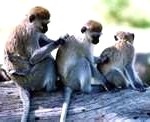
monkeys grooming
The ‘vervet monkey’ is the national animal of Saint Kitts and Nevis in the Caribbean Sea; and the ‘Barbary macaque’ (monkey) is the national animals of Gibraltar.
Monkeys spend most of their free time grooming one another in order to keep themselves clean and maintain good social relationship in the troop.
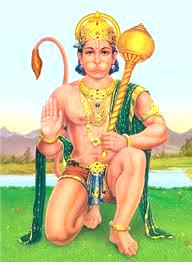
Lord Hanuman, the monkey god
Some people in some parts of the world eat monkeys; and some people keep the smaller species as pets. However, animal experts do not recommend keeping monkeys as pets!
Monkeys are extensively used in scientific research and also in space exploration as they closely related to people!
In Hindu religion, the monkey is worshipped as a deity; in Buddhism also the monkey is highly respected!
In astrology, the ‘monkey’ is the ninth in 12-year cycle of animal in Chinese Zodiac.
And monkeys are mentioned in several children’s story books; shown on TV; and films on monkeys using the real trained and wild monkeys have been made!!
More from Animals in Language
Python
python: a large python a kind of snake -- reptile -- usually large, muscular and powerful -- grows to 1 metre …
Animals-Adder-Aye-Aye
A B C D E F G H I J K L M N O P Q R S T …