


muskrat
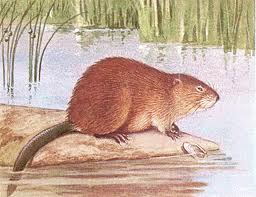
a kind of animal – mammal – rodent – semi-aquatic (= lives in or near water most of the time) related to the voles and lemmings (not a ‘true’ rat) – stocky medium-sized with short thick brown fur, short pointed snout (= mouth and nose part), small ears, whiskers around the mouth part, small round eyes, short legs – front feet with sharp claws back legs with semi-webbed feet (= toes partly joined by a thin layer of skin), long tail covered with scales (not hair), flattened side to side; size: 1-2 feet long plus 8-10 inch long tail, and weight: 700 grams to 1 Kg; feeds mostly on (eats) water plants, and occasionally small fish, frogs and mussels; lives for 4-5 years (some individuals can live up to 10 years) one separate species in the family, found originally in the wetlands – near streams, lakes and ponds of North America, but spread to some parts of Europe and Asia
As the name suggests, muskrats secrete a strong smelling yellowish oily substance, called ‘musk’, to mark their areas and for communication. This strong smelling substance is not as popular or important as that of the ‘musk deer’.
Muskrats are hunted for their valuable fur (hair), and occasionally for their meat!
Muskrats spend most of their time in water. They can swim well with the help of their flattened tail; they are known to stay under water for about 15 minutes!
Muskrats make nests, burrows, and even build dome-shaped ‘houses’ that are about 2-3 feet above water level, but the entrance is always below water, like that of a ‘beaver’s lodge’. The ‘beaver’s lodge’ is built with tree branches, but the muskrat’s house is built with mud mixed with leaves!
Muskrats are considered pests in some parts of Europe as the burrows they make in the banks of water bodies damage those banks and cause floods.
More from Animals in Language
Python
python: a large python a kind of snake -- reptile -- usually large, muscular and powerful -- grows to 1 metre …
Animals-Adder-Aye-Aye
A B C D E F G H I J K L M N O P Q R S T …