


okapi
(also called ‘forest giraffe’ — for the right pronunciation of okapi, please click here)
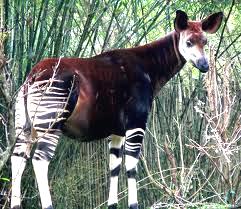
a kind of animal – mammal – four-legged – grass-eating – looks like (resembles) the zebra, but closely related to the giraffe – stout body with sloping back, reddish-black back, horizontal black and white stripes on the front and back legs and the rump (back part), white stockings (long socks-like) on the lower legs, black hooves, cone-shaped head with white jaws and black muzzle, large clear eyes, large straight ears, two short skin-covered horns (only in males), called ‘knobs’, long pointed muzzle (= mouth and nose part), long blue tongue, relatively long neck (but much smaller than that of a giraffe’s), front legs longer than the back ones, 1-1½ feet-long tail; size: 5-6½ feet tall at the shoulder, 6-8 feet long, and weight: 200-300 Kg (females are slightly larger than males); feeds on (eats) leaves, buds, fruit of trees, and grasses, ferns and fungi; lives for 25-30 years; native to the rainforest in the northeast of the Democratic Republic of the Congo (formerly, Zaire), in central Africa, but now found in many zoos around the world
female ~~ cow
baby ~~ calf
group ~~ herd {but okapi live alone, they usually do not live in groups}
voice (call) ~~ moo; chuff; bleat (babies ‘bleat’)
The okapi is the national animals of the Democratic Republic of the Congo, Africa.
The okapi is a curious animal; it is a 3-in-1 animal: looks like (resembles) a horse, from the shape; resembles a zebra, from the zebra-like stripes on its legs and rump; and biologically closely related to the giraffe, and, in addition, from the long tongue, the gait (= the way of walking), the skin-covered knobs (horns) in males, which are the basic features of a giraffe!
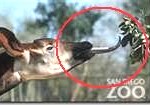
The okapi’s tongue is so long that it can clean its ears inside out with its own tongue!
More from Animals in Language
Python
python: a large python a kind of snake -- reptile -- usually large, muscular and powerful -- grows to 1 metre …

Animals-Adder-Aye-Aye
A B C D E F G H I J K L M N O P Q R S T …