


ostrich
[For the right pronunciation, please click here.]
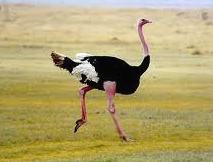
a kind of bird – flightless (= cannot fly) belongs to ratites – large, (male) black feathers with white at the tips of wings and tail, (female) greyish-brown with white tips on wings, no feathers on the head, neck and legs, small head with large eyes, flat and broad beak (bill) with a round tip, relatively large wing without flight feathers, long strong legs with only two stout toes on each foot with a long nail on only one toe; size: 5½-9 feet tall, and weight: 90-160 Kg (male larger than female); feeds on plant matter, insects and small animals, such as lizards, small snakes, etc; lives, on average, for 50 years, but some individuals can live for up to 75 years; four sub-species, native to Africa, but now farmed in about 50 countries all over the world
female ~~ hen
baby ~~ chick
group ~~ flock (herd)
voice (call) ~~ {no particular name} drumming sounds with clicks; hiss; cluck (?)
home ~~ nest (a small depression on the ground used for laying eggs)
movement ~~ walk, run
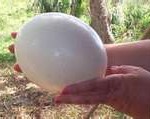
The ostrich is the largest flightless bird; and, in general, the largest and the heaviest of all birds; and it is the bird with the largest egg, weighing about 1½ Kg! {However, when compared to the bird’s body size, an ostrich’s egg is the smallest one!?}

(with only two toes on each leg)
The ostrich is also the fastest land bird, and the fastest of all two-legged land animals!
Ostriches have been associated with the human civilisations since the ancient Roman times. Ostriches are found in the ancient art and scriptures of several ancient cultures!

(bag made of ostrich skin)
Ostriches have been hunted for their meat which is said to taste like ‘beef’; for skin which is used to make leather goods; for feathers which are used in decorating people’s hats, caps and clothes and also used in making ‘feather dusters’.
The ostrich egg shells are so strong that they are made into beautiful decorative objects.
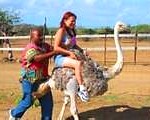
Ostriches are very strong, and an average sized person can take ride on its back. These largest and strongest birds are used in races, too!
When an ostrich suspects an attack, it sits flat on the ground with its neck and head stretched level to the ground so that the enemy sees only a bush or pile of dirt on the ground. But when attacked from very close quarters, the ostrich tries to run away from the enemy, and when that does not work out well, it tries to kick the enemy with its very powerful legs (It is said that an ostrich can break the leg of a person with its single kick!). There are some eye-witness accounts about an ostrich kicking a lion and injuring it!

(hiding from enemies?)
The saying or belief that ostriches ‘bury their heads in the sand’ to escape from the enemies or predators is a myth – a long-standing belief that is not based on true facts!
One of its ways of escaping from enemies is to sit low on the ground and to press its long bare neck and bare head close to the earth so that the enemy does not see the whole body shape of the bird, but sees only the body bulk which, with all those loose feathers and in the bright sun, may look like a dry bush. This strange act may have prompted some over-imaginative people to make up this story of “ostriches burying their heads in the sand”!!
1.
ostrich (noun) = a person who refuses to accept the facts, the truth or the real depth of a danger or problem, and the reality of life on purpose, expecting those problems to solve by some miracle or something else
2.
ostrich-stomach [said of someone’s stomach that can digest anything]
3.
ostrich policy, belief, etc. [said of a policy, belief, etc. that are formulated (made) by avoiding the facts, possible dangers and the reality of life on purpose (= knows about the facts, dangers, and the reality but not does not take into consideration)
Return to “ostrich” in People & Professions.
More from Animals in Language
Python
python: a large python a kind of snake -- reptile -- usually large, muscular and powerful -- grows to 1 metre …
Animals-Adder-Aye-Aye
A B C D E F G H I J K L M N O P Q R S T …