


oyster
(plural: ‘oystersclick here‘; for the right pronunciation, please .)
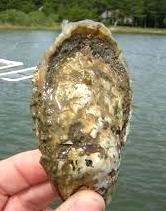
an oyster
a kind of animal – sea mollusc – bivalve shellfish (= with two valves) – two main types: ‘true’ or ‘edible’ oyster, and ‘pearl’ oyster – very soft body in two hard coverings, called shells; size: (varies widely) from the smallest only 1-1¼ inch to the largest13 inch long, 6 inches wide, and weight: 750 grams, on average 4-6 inch long and weighs about 200-250 grams; feeds on (eats) plankton (= very small animals floating in water) by filter feeding; lives for 20-30 years; about 400 species (kinds) found in almost all warm waters of the world

oyster farmer at work
female ~~ female
baby ~~ larvae; spat
group ~~ bed; hive; cast; clutch
{The cream coloured soft oyster meat inside the shells is also called ‘oyster’.}
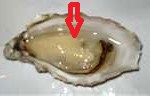
the soft & fleshy oyster between the shells
Oysters are an important food source not only for people but also for many sea animals. Oysters, known to be full of nutrients, vitamins and minerals, have been eaten raw or cooked (only the soft body in the shells) by people since ancient times!
Like most bivalve molluscs, oysters also produce ‘pearls’ which are used in ornaments. Pearls are nothing but some very small particle, such as a grain of sand or any non-edible thing that gets into the shell house of oyster. As the oyster cannot throw it away, it covers the ‘foreign body’ (speck of grain) with a substance called ‘nacre’ which, after several years and getting hard, becomes a ‘pearl’ as we know. The natural cream coloured pearls are very expensive. The colour of the pearl depends on the nature of the ‘foreign body’ and the species of oyster!
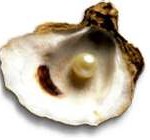
(the oyster pearl that grows between the shells)
Oysters can change their sexes, and they can be male at one stage of their life and female at another stage. The female releases thousands of eggs directly into the water and the female releases its sperm, and the eggs fertilise in water!
The American oyster releases five hundred million eggs in a year!! Unfortunately, only one percent of these thousands of eggs grow into larvae, and even fewer grow into spats!
Oysters are very useful: by filter feeding, they clean the water they live in!
Oysters are grown on ‘oyster farms’ for their meat and pearls!
1. oyster (noun) =
(a) a shy, silent person who does not like to talk to others
(b) a special delicacy (= some food item that is eaten on special occasion)
(c) something, like an activity or scheme, from which one gets many benefits
(d) a piece of muscle (flesh) that is found in the bone part of the back of a fowl (‘fowl’ = the birds that people eat)
(e) the greyish-white colour
2. oyster-part = a character or role that has no dialogue or words in a show or play
3. as mum as an oyster (‘mum’, in this context, = silent, not saying anything to anybody)
4. to gape like an oyster for the tide (‘gape’ = to open one’s mouth wide when looking at something in wonderment or surprise; to yawn; as a noun, a wide openings;)
5. as dumb as an oyster
6. to keep the oyster = to keep the best part of something for oneself
7. (a) the world is in his oyster
(b) the world is your/his oyster [said of a person’s position where he has every chance to prosper or do as he likes]
More from Animals in Language
Python
python: a large python a kind of snake -- reptile -- usually large, muscular and powerful -- grows to 1 metre …
Animals-Adder-Aye-Aye
A B C D E F G H I J K L M N O P Q R S T …