


pangolin
(also known as ‘scaly anteater’ or ‘trenggiling‘; for the right pronunciation, please click here)

a tree pangolin
a kind of animal – mammal – nocturnal (active at night) – four-legged – insect eating – medium-sized with long body covered with hard sharp scales on the outer side and plain skin under side, long narrow head with very long snout (= mouth and nose part), no teeth, very long tongue, very long thick tail(16-19 inches long), and short legs with long claws on the front (forefeet) feet, and strong back (hind legs) legs; size: (the smallest ‘long-tailed pangolin’) 2-3 feet long, including the 1-2 feet long tail, and weight: 2-3, (the largest ‘giant pangolin’) 5-6 feet long, including 2-3 feet long tail, and weight: 30-35 Kg (females smaller than males); feeds mainly on (eats) ants and termites; about 8 species found in tropical regions of Africa and Asia
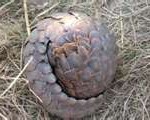
The pangolin is a peculiar animal. Though it is a mammal, it has scales instead of hair on its body, like reptiles and fish! In fact, it is the only mammal with scales on its body!
The front feet of a pangolin are short and have very long claws which make it difficult for it to walk with open paws; therefore, the pangolin turns the front feet inside and walk on the wrists. With the help of their long sharp front claws, the pangolin tears open the ant hill or termite mound to get to the ants and termites inside the hill. The tree-living pangolins also use their sharp long claws to rip the bark of the trees to get to the ants or other insects that live under the bark!
Pangolins are often called scaly anteaters, which is a very good description for them, even though they are not closely related to anteaters, but are related to cats, dogs, bears, etc.
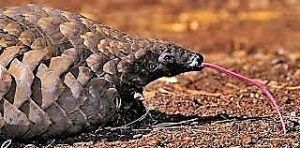
a long sticky tongue
Pangolins, like ant-eaters, have a very long, very sticky rod-like tongue, which may grow up to 1½-3 feet long, with which they scoop or flick out the ants and termites from their mounds!
Pangolins are very choosy eaters; of all the numerous species of ants and termites, they eat only 19 species of them!
Tree pangolins climb trees, and most pangolins can swim well!
Though pangolins have poor eye-sight, they have very good sense of hearing and smell.
The tail of the pangolin is long, scaly and prehensile (‘prehensile’ = a part of a body used for different purposes) tail with a length of 2-3 feet, with which the tree pangolin hangs to branches of trees; and lashes at the predators (= animals that try to kill and eat it)! The sharp hard scales on the tail are known to injure other animals, including people!
Like a hedgehog, the pangolin also rolls into a ball keeping its scale-less face and underside inside the ball when attacked so that the hard scales make it impossible for the predators to bite it!
Pangolins are hunted for their meat which some people eat for fun, and because some people believe that eating pangolins makes them more energetic in sex (animal experts say that the belief is baseless and there is no scientific proof); and for their scales which are used in folk medicine for skin diseases, and the skin with the scales on it is made into clothes which some people like to wear!!
More from Animals in Language
Python
python: a large python a kind of snake -- reptile -- usually large, muscular and powerful -- grows to 1 metre …

Animals-Adder-Aye-Aye
A B C D E F G H I J K L M N O P Q R S T …