


pelican
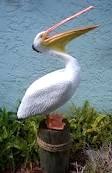
a kind of bird – water bird – related to the cormorant, booby — relatively large, with white feathers boarded with black on the wing edges, round head with large long beak with a beak pouch (= a bag-like skin fold attached to the lower part of the beak and the neck part below the beak), long slender neck, stout body, relatively short tail, short legs with webbed feet (= a layer of thin skin between the toes); size: the smallest (brown pelican) 3½ feet in length and 3 Kg. in weight, the largest (Dalmatian pelican) 5-6 feet in length and 15 Kg. in weight; feeds mainly on (eats) fish, and also frogs, snails, shrimp and, now and then, some small birds; lives for 15-25 years (some individuals are known to live for 45-50 years); about 8 species found all over the world, except Antarctica
Some common pelicans are: brown pelican, Peruvian pelican, American white pelican, great white pelican, Dalmatian pelican, pink-backed pelican, spot-billed pelican, Australian pelican, eastern white pelican,
female ~~ hen/female
baby ~~ chick
group ~~ ‘pod’ on water while fishing (in flight ‘flock’; on land ‘colony’)
voice ~~ — (low,hoarse sound)
home ~~ (some nest on land; some in trees)
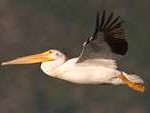
The ‘great white pelican’ is the national bird of Romania, Europe.
The ‘brown pelican’ is the national bird of Saint Kitts and Nevis, West Indies.
The ‘eastern brown pelican’ is the province bird of Louisiana, USA.
The ‘spot-billed pelican’ is the province bird of Sindh province in Pakistan, Asia.
The Australian pelican has the longest beak in the bird world!

beak pouch
The most striking feature of the pelican is its beak and the beak pouch which the bird uses to catch fish in the water. A pelican’s beak pouch can hold 11 1/2 litres (3 gallons) of water. The pelican scoops the fish along with the water and then presses the pouch against its chest to let out the water then turns the fish head first and swallows it whole!
There is evidence to show that pelicans can scoop up small birds even on the ground, such as a live pigeon, and swallows them whole!!
Pelicans do not use their beaks (bills) to carry their young, as is believed by some people; they use those beaks only to catch the fish or some other food!
The South American ancient cultures worshipped the pelican, and depicted them in their art; in medieval Europe, people believed pelicans could bring back their dead chicks to life by giving them their own blood, and basing on this myth (= base-less belief) the pelican was associated with the “sacrifice of Jesus Christ”!!
There are pelican mentioned in the fables, stories, and several organisation, including the Cambridge and Oxford Colleges in England and else where, have been using the pelican as their emblem and in their logos!

(a pelican crossing)
1.
pelican itch (also ‘swimmers itch’) = a kind of skin rash (itch) that people who swim or wade in water that is infected by a kind of parasite that that lives mostly in birds
2.
a long streak of pelican shit = {Australian usage} a tall person
3.
a pelican crossing = a road crossing system where the people crossing a road use an electric device by pressing a button on it when they want to cross, which then lights/shows up red light to the motor traffic and green light to the people so that they (pedestrians/people on foot) cross the road safely — pelican crossings are usually found at road crossings that are not used by a lot of people continuously
More from Animals in Language
Python
python: a large python a kind of snake -- reptile -- usually large, muscular and powerful -- grows to 1 metre …

Animals-Adder-Aye-Aye
A B C D E F G H I J K L M N O P Q R S T …