


pig
(also called ‘hog’, ‘swine’; for the right pronunciation, please click here)

a kind of animal – mammal – four legged and hoofed – thick skinned (pachyderm) – mostly domesticated – medium-sized stout (fatty), relatively long, body with short rough (coarse) hair of different colours, usually pink or black, large head, medium-sized ears (erect ears in some kinds and droopy ears in some other kinds), small eyes, long blunt snout (= mouth and nose part), short thick neck, short legs with hooves, short thin curly tail; size: on average, 1½-2½ feet tall at the shoulder, 2½-3½ long, and weight: about 150-200 Kg (depends on the breed and the food given); feeds on (eats) mostly plant matter – grain, seeds, shoots, fruit, vegetables, and insects, small animals, including dead animals (carrion); lives for 10-15 years (pigs grown on farms for meat live only for 4-5 years; pigs in the wild may live for 25 years); several breeds found all over the world, except in the colder parts
female ~~ sow (mature female given birth to piglets); gilt (grown up female but not given birth to any piglets yet)
baby ~~ piglet; shot; farrow
group ~~ drove, drift, hoggery, herd, sounder, team, passel, flock; litter; farrow (all the babies born to one sow in one delivery)
voice (call) ~~ grunt, oink, squeal
home ~~ {man-made} sty, pigsty, pigpen, piggery
The meat of a pig eaten by people is generally called ‘pork’. “Ham” and “bacon” are also the names used for the meat of a pig; ‘ham’ is the meat from the back leg, and ‘bacon’ is from the side of the pig.
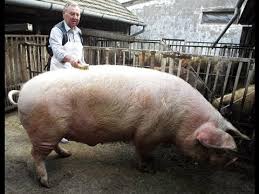
a huge pig
Pigs have been a major source of food for the people for thousands of years.
Pigs are considered one of the first domesticated animals, even before cattle.
Pigs are very adaptable, and eat anything, including the edibles from the garbage dumps near human settlements.
A pig is branded dirty, and people who keep themselves dirty are compared to pigs. Nevertheless, pigs are not all that dirty, because they do not have sweat glands, they wallow (roll up) in mud to keep themselves cool and to protect themselves from insects!
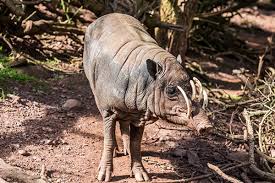
a barbirusa
Though pigs are mainly hunted or kept for their meat, their thick skin is also used in leather industry, and the coarse (rough) hair is used in making paint brushes!
Barbirusa, a kind of wild pig, has some dental problem – the upper tusks (teeth) grow up through the top of its upper muzzle part!
In literary world, the pig is found in children’s stories, nursery rhymes, poems, TV and radio programmes, motion pictures (films), and in religion!
In Hindu religion, the supreme God takes up the form of a pig (varaha avatar) to save the Earth from drowning in the deluge!
In China, where pigs are favoured as an important food, the Chinese celebrate the “Pig of God” festival every year when they exhibit the fattest of all the pigs!
The pig meat (pork), however, is banned by some religions, such as Hinduism, Islam and Judaism.

a sow & piglets
The world famous “piggy bank”, a coin collection container, has been designed to instil money saving habit in the children. The origin of the word ‘piggy’, however, has nothing to do with the animal ‘pig’; it is ‘pigg’, a kind of clay used for making ceramic or porcelain jars used in the kitchen. From the “pigg jars” the name gradually changed and finally come to be called ‘piggy bank’!

a most popular piggy bank

pigg jars (porcelain jars)
The ‘piggy bank’ is also called ‘penny bank’ and ‘money box’, and these days there are piggy banks not only in the shape of a pig but also in the shape of other animals, and they are made of not only the porcelain but also plastic or fibre glass! {Some orthodox Muslims show their dissatisfaction about the name “piggy bank”, not knowing the origin, and wanted the banks to change the name and the shape of the animal because in Islam it is believed that the pig is one of the animals that have to be avoided – not only eating but also mentioning its name!!}
More from Animals in Language
Python
python: a large python a kind of snake -- reptile -- usually large, muscular and powerful -- grows to 1 metre …

Animals-Adder-Aye-Aye
A B C D E F G H I J K L M N O P Q R S T …