


pug
[For the right pronunciation, please click here.]
[A]
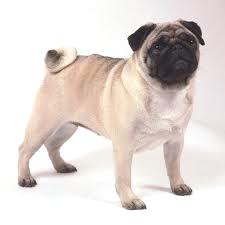
(also known as (earlier Chinese name: ‘Lo Chiang-sze’ shortened to ‘Lo-Sze’) ‘pug dog’, ‘Chinese pug’, ‘Chinese pug dog’, ‘mini mastiff’, ‘puggu’, ‘mops’ or ‘mopshound’ in Germany & Holland, ‘mopsi’ in Finland, ‘Dutch bulldog’, ‘Dutch mastiff’, ‘carline’ in France; ‘doguillo’ in Spain, ‘Caganlino; in Italy) a breed of dog – related to the boxers – small square, compact, muscular body with smooth shiny fawn, (light cream), silver or black coat (hair),
 round face with a lot of creases (skin folds), broad forehead, medium-sized smooth drooping black or grey ears, (rose or button type ears with button type being more popular), round clear eyes shaded by heavy eye-brows, blunt, pressed-in black muzzle (mouth and nose part), wide mouth, sharp teeth – lower teeth slightly jetting out, short thick neck, deep chest, straight legs, medium-sized tail curved or double curved up on the back; size: 10-15 inches, and weight: 6-9 Kg; feeds on the usual dog food; lives for 12-15 years; originally from China, but now found almost all over the world
female ~~ bitch
baby~~ pup; puglet
group ~~ grumble; pack (?)
voice (call) ~~ bark
home ~~ (man-made) kennel; dog-house
Pugs are one of the popular pet dogs. The pug is described as “a lot of dog in a little size”! Pugs are found in many stories and comics and cartoons: the character named ‘Frank the pug’ featured in the motion picture ‘Men in Black 2’ is a pug!
[B]

a pug moth
a kind of moth (insect), called ‘pug moth’ or just ‘pug’
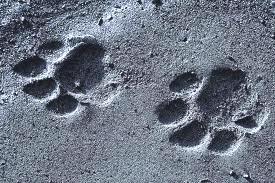
tiger pugs/pugmarks
More from Animals in Language
Python
python: a large python a kind of snake -- reptile -- usually large, muscular and powerful -- grows to 1 metre …

Animals-Adder-Aye-Aye
A B C D E F G H I J K L M N O P Q R S T …