


reptile
[For the right pronunciation, please click here.]
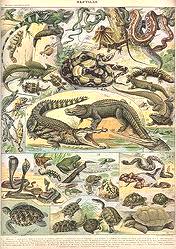
reptiles
a kind of animal – air-breathing with lungs – cold-blooded (= body temperature changes depending on the weather condition, so external heating, such as the ‘sun’s heat’ needed to maintain the body temperature; the advanced name for ‘cold-blooded’ is “ectothermic”, and the animals with this feature are called “ectothermes”) – with a back-bone and internal skeleton (bones) – body covered with mostly scales or horny plates – mostly four-legged (some are without legs, such as snakes; and some are with very small legs), short legs with sharp claws placed on the side of the body so that the walking looks like crawling – mostly egg-laying (some species give birth to live young babies) – mostly live on land (some species live in trees, and some others in water); size: (varies greatly) the smallest (tiny gecko) ¾ of an inch (0.6 inch/1.6 cm) long, and weight: 5 grams, lives for 3-4 years, and the largest (saltwater crocodile) 15-18 feet long, and weight: from 500 Kg. to 1 ton (1,000 Kg.), lives for about 70 years; feeds on (eats) — small reptiles mostly on insects, and large reptiles on insects, other small to big animals, birds and bird eggs, and other reptiles; about 8,000 species, found all over the world, except Antarctica
crocodilia: alligators, crocodiles, caimans, gavials; sphenodontia: tuatara; squamata: lizards, snakes, worm-lizards; testudines: turtles, tortoises, terrapins
The dinosaurs which started living some 300 millions ago, ruled the Earth for about 160 million years and died out some 65 million years ago were ‘reptiles’, and the bird-like flying animals that lived along with the donosaurs were called ‘flying reptiles’!
reptile (or reptilian) (noun) = (a) (of a person or thing) nasty; disloyal; treacherous
(b) to be in constant fear of something or someone; to be in obedience to someone powerful
More from Animals in Language
Python
python: a large python a kind of snake -- reptile -- usually large, muscular and powerful -- grows to 1 metre …

Animals-Adder-Aye-Aye
A B C D E F G H I J K L M N O P Q R S T …