


robin
There are two popular ‘robin’ species – the American robin and the European robin. These two varieties, however, are not related; they are named robin because of the orange-red patch on their breast!
[a]
American Robin:

an American Robin
a kind of bird – song bird – diurnal (= active during the day) – insectivore (= feeds mostly on insects) – related to the thrush bird family – small with black or grey feathers on the round head and white with black streaks on the throat, average pointed black beak (bill), round clear eyes, brown back and reddish-orange breast, relatively long tail, medium-sized slender legs; size: 10-12 inches long, and weight: about 80 grams; feeds on (eats) mostly insects, caterpillars, spiders, worms, and fruit and berries; lives for (if a young bird survives the first year, it may live for 2-3 or 5-6 years; the longest lived bird on record was 13 years); about 7 sub-species found in North America
The ‘American robin’ is the state bird of Connecticut, Michigan and Wisconsin states, USA.
The robin is considered a symbol of spring season – the ‘harbinger of spring’!
The robin is a migratory bird, i.e. it flies away to other warmer parts during winter, and returns to the home place when the weather is warm.
The robin is found on the Canadian $ 2 note. {This currency note was withdrawn from circulation.}
In Quebec, Canada, the superstition (= a sentimental belief) is that whoever sees the first robin of spring will have luck!
_________________________________
[b]
European robin:
(also ‘English robin’, ‘robin’, ‘redbreast’, ‘robin redbreast’)
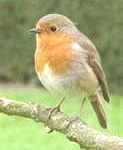
a European robin
a kind of bird – song bird – diurnal (= active during the day) – insectivore (= feeds mostly on insects) – related to the flycatcher bird family – small with bluish-grey on the head and sides of the head, clear round eyes, medium-sized sharp, pointed brown or black beak (bill), grey back and wings, white under parts, orange/red breast patch, moderate tail, medium-sized slender legs; size: 5-6 inch long, and weight: 15-24 grams; feeds on (eats) mostly insects, worms, spiders, and fruit and seeds; lives for (if a young bird survives the first year, it may live for 2-3 or 5-6 years; the longest lived bird on record was 14 years); several sub-species found in Europe, Eurasia, Iceland
The robin is a very popular song bird in Britain and other parts of Europe.
It is considered a symbol of spring season – the ‘harbinger of spring’!
The robin is mention in several popular poems, in stories for children, in comics and in art-work!
The pictures of robin are seen on Christmas greeting cards. The symbolism is that the postmen are delivering the cards, because in Victorian Britain postmen wore red uniform!
Several sports and business establishments have the robin in their logos. Some of the English professional football clubs are nicknamed ‘the Robin’!
__________________________________
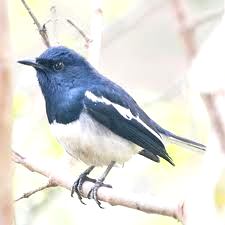
an oriental magpie robin

a sea robin (fish)
The ‘sea robin’, however, is a kind of fish with bony head and long side fins with extended rays with which the fish feels for the food on the bottom of the seas. The striking features of this fish are: it makes sounds with its air-bladder and ‘walks’ on the bottom of the water bed with the help of its feelers in search of food!
1. cock-robin = the reflections of sun rays on water
2. as dead/naked/ragged/wet/peart as a robin (‘peart’ = lively, brisk)
3. one bush cannot harbour two robins [said to advise that those who like to have more space around them should not stay close to one another]
More from Animals in Language
Python
python: a large python a kind of snake -- reptile -- usually large, muscular and powerful -- grows to 1 metre …

Animals-Adder-Aye-Aye
A B C D E F G H I J K L M N O P Q R S T …