


snake
(For the right pronunciation of snake, please click here.)

land snake with its hood
a kind of animal – reptile – legless – meat-eating – coldblooded (‘coldblooded’ = the temperate (heat) of the body depends on the weather condition – the advanced name for ‘coldblooded’ is ‘ectothermic’) – egg-laying (some species give birth to live young) – long, elongated (slender) body covered in scales, each species in its own colour and pattern, flat, pointed head with round clear eyes without eye-lids, large mouth with a long forked tongue, teeth-like growth (only to hold the prey from escaping, not for biting or chewing), (in some venomous (poisonous) species) two sharp hollow down-ward curved teeth, called ‘fangs’, on the upper jaw with which to bite and inject venom into prey;
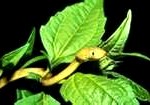
a tree snake
loosely joined jaws which can be opened wide to swallow prey, long, pointed tail; size: (varies widely) from less than 4 inches to 33 feet long, and weight: from a few grams to 400 Kg; feeds on (eats) insects, mice, rats, lizards, monkeys, birds and bird eggs, (some large species) deer, antelope, buffalo, (some water-living species) shellfish, fish, (some large species) other smaller snakes; lives for, on average, 10-15 years (some species live for 20-25 years); about 2,900 species (some animal experts put the figure at 3,100 species), found on all the continents, except Antarctica {However, no snakes are found (not native to) Hawaii, Iceland, Ireland, New Zealand and Bermuda (?).}
Snakes are of three types: venomous (poison in the bite); constrictors (do not bite but coils [winds] around the prey and squeezes it to death); and non-venomous (just grabs the prey and swallows it live)!
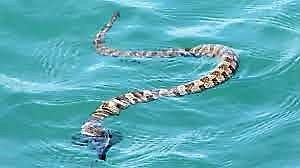
a water snake
female ~~ female
baby ~~ snakelet
group ~~ bed, knot, slither, nest
voice ~~ hiss
home ~~ den, pit, nest
movement ~~ crawl, creep, glide
a snake with an arm
More from Animals in Language
Python
python: a large python a kind of snake -- reptile -- usually large, muscular and powerful -- grows to 1 metre …
Animals-Adder-Aye-Aye
A B C D E F G H I J K L M N O P Q R S T …