


spider
(also less commonly ‘arain’)
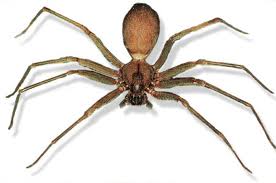
a kind of animal – arachnid – no back-bone or inner skeleton – with an exoskeleton (= tough flexible substance that covers the outer body) – mostly nocturnal (= active at night) – egg-laying – related to the scorpions – body in two parts – thorax (head) and large round or oval-shaped abdomen, small head with no teeth but with a pair of fangs (sharp, curved tooth-like hallow organs with which to inject venom (poison)), (in some species) four pairs of eyes (in some others) three pairs or no eyes at all, four pairs (8) of jointed legs; size: (varies widely) from the smallest (dwarf spider) 0.05 inch to the largest (tarantula) 3½-4 inches in body length – 10 inches across when legs spread – mostly, on average 1-1½ inch long; feeds on insects, (and the young and sometimes the adults) pollen and nectar of flowers; lives for, on average, 2-3 years (the tarantula is known to live for 25-30 years in captivity); about 40,000 species found all over the world
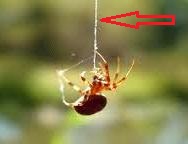
a spider hanging from its own thread
female ~~ female
baby ~~ spiderling
group ~~ cluster, clutter, venom
home ~~ web (spider web); cobweb; burrow
movement ~~ crawl

(a spider web/cobweb)
Spiders are arachnids which means their body is divided into two parts, they have eight legs, they have venom glands (= organs to produce poison that is injected into their prey through their fangs).
Most of the spiders have the ability to make webs, but a few species do not weave any webs.
Spiders’ webs are one of nature’s marvels. The cobweb, ‘the silk thread’, which the spider produces from the tip of its abdomen with the help of special glands, called ‘spinnerets’, may look thin and flimsy but it is a death trap for most insects.
The silk which is in liquid form changes to very thin thread-like form when it is brought out of the body.
The spider web, the ‘silk thread’, is the ‘second’ strongest natural organic chemical in the world! Scientists are trying to find ways to use the spider web for our benefit because it is light, does not rust because it is natural, yet it is stronger than any man-made material of the same size! (Studies in 2015 show that the teeth on the sea animal limpet have a material called ‘goethite’ which is much stronger than any spider’s silk, thus becoming the strongest organic material found in nature.)
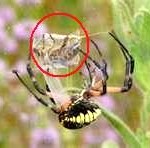
spider packing a meal
Note: Strictly speaking, a ‘spider web’ is the one which is clean and still being used by the spider that made it, and a “cobweb” is a dirty, torn web that has been abandoned by the spider; in causal usage, however, people tend to use these two expressions interchangeably!
Spiders use their web to catch (trap) their prey which are mostly insects. There are some species which do not make webs, like the ‘trapdoor spider’, which build a small burrow in the ground, with a door which snaps shut when an insect enters the burrow; and there are some species, like the ‘wolf spider’, hunt their prey, chasing them around!
Spiders come in many colours, and, some species, with different coloured patterns.
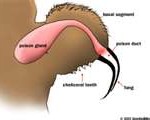
a spider’s fang
Some species, such as the crab spider, can change their colour to blend in with their surroundings. The ‘crab spider’ walks (crawls) side-ways as a crab does!
Most species of spiders are venomous, i.e. they can inject poison into their prey with the sharp fangs they have. That poison paralyses the prey, and also makes the prey turn into liquid so that the spider can suck up the juice!
Adult spiders of most species can take only liquid food; they have no teeth-like organs to eat solid food, and their digestive system is not strong enough to digest the solid food! They have two types of digestive system — one, they send in enzymes into the prey and suck up the digested juices, and the second one, they crush/grind the prey into a pulp and then suck up it up into the digestive system which is filled with enzymes!!

a spider’s body parts in its two segments
All spiders are insectivores – feed on insects, but some large species eat small animals, such as mice, bats, and birds!
Recent scientific studies show us that the spiders have been on the earth, trapping insects in their webs for millions of years – even at the time of dinosaurs!!
Spiders have been mentioned in the scriptures of several ancient cultures. The native South American tribes worshipped animals, and included spider, along with other animals, in their art! Spiders in scriptures and folklore stand for fear, patience, mischief and malice!
In Greek mythology, an expert weaver, called ‘Arachne’, was changed into a spider because she wove better than the goddess Athena did. “Arachne” in Greek means ‘spider’!
In modern times, spiders, especially the large species, such as the ‘tarantulas’, are eaten in some parts of the world, kept as pets in homes, and also used in scientific research!
The ‘black widow’ of the USA is one of the few species of spiders whose venom (poison) can kill a person!
Spider venom is non-toxic and is used in pesticides and in making medicine!
‘Arachnophobia’ is a kind of abnormal fear of spiders. Some people, especially young women, show signs of unexplained fear of spiders and stay away from them.
Spiders are also found as lead characters in several stories, fables, comics, cartoons, and in horror motion pictures (films/movies)!
There are some insect-like creatures that have ‘spider’ in their names but do not belong to ‘true spiders’. Some of them are: shepherd, harvest spider or harvestman, etc.
The ‘cellar spider’ is a true spider and it is also called ‘house spider’, ‘vibrating spider’, ‘harvest spider’ and ‘daddylonglegs’.
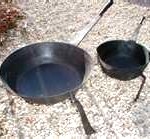
spiders, a kind of frying pans
1.
spider (noun) =
(a) {the USA English} a kind of frying pan
(b) a kind of metal stand with very short legs used for keeping hot dishes on a dinning table

the spider man
2.
spider-man =
(a) a man capable of working even at great heights
(b) the popular character of children’s comics
3.
spider-and-fly [said of the relationship of the one who does harm and the one who is harmed]
4.
spider-work = good quality, well-darned netting (‘darn’, in this context, = to close up a hole or tear in a piece of clothing by sewing with fine thread and needle)
5.
as cruel as a spider (or atter) (‘atter’ = spider)
6.
to look like a spider in a pan of milk = unimportant, insignificant
7.
to weave spider webs for … (someone) = to set traps for someone or something
8.
laws are like spider’s web that catches flies but let hornets (or wasps) go free [said to mean that laws are severe or very strict with petty offenders (small-time thieves) but not with serious, powerful or influential criminals]
9.
to swallow a spider = to go bankrupt, i.e. to lose all the money in a business, and not have any to clear debts

(a sample of spidery writing)
10.
enough to deafen a spider [said of a prolonged, boring discussion or lecture]
11.
every spider winds his own ball of thread [said to imply that everybody takes care (must take care) of his own interests]
12.
where the bee sucks honey, the spider sucks poison [said to imply that different people get different results from the same opportunities]
13.
spidery writing = small, beautiful but fussy handwriting
More from Animals in Language
Python
python: a large python a kind of snake -- reptile -- usually large, muscular and powerful -- grows to 1 metre …
Animals-Adder-Aye-Aye
A B C D E F G H I J K L M N O P Q R S T …