


springbok

a kind of animal – mammal – four-legged – grass-eating – related to the gazelles and belong to the antelope family – medium-sized with tan (light brown) on the upper side and white on the face and the under side, a thick dark (black) stripe running along each side from the shoulder of the front leg to the thigh of the back (hind) leg, cone-shaped head with two inward-curved horns, relatively long leaf-like curved straight ears, round clear eyes, a black line on either side of the face running along from the eyes to the nose, long snout (= mouth and nose part), long slender neck, long slim legs, relatively short tail; size: 2-3 feet tall at the shoulder, 3-4 feet long, and 30-50 Kg. (male larger than the female); feeds on (eats) grasses, leaves, flowers, buds and shoots; lives for, on average, 10 years; found in the south and western Africa
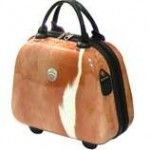
springbok skin bag
female ~~ ewe
baby ~~ fawn; kid; lamb
group ~~ herd
voice (call) ~~ (adult) grunt; (fawn) bleat

(springbok logo)
The springbok, along with the ‘elephant’ (?), is the national animal of South Africa. The springbok is the name of the national rugby team, and the emblem of the team.
The springbok herds are (or used to be) the largest migratory herds on record!
The springbok is an elegant antelope which can sprint at speeds of 80 K/mp!

springbok pronking
The most striking feature of the springbok is the ‘jumping’ in the air when excited or during the mating season. The animal jumps up into the air, often 10-13 feet high, with the back arched, legs kept stiff, and head bent down, and after landing from one jump it immediately goes up into the air again and again for several time, like a rubber ball bouncing. This jumping is called ‘pronking’ or ‘stotting’. Different animal experts have different opinions on this peculiar activity. Some experts think they do this to warn the predators that they are alert, and some others think it is a kind of ‘show off’ – showing one’s strength to the predators and/or to attract the female during breeding season.
The other peculiar feature is the pouch-like white-haired skin fold on the back of the springbok which opens up like a fan of white hair when the springbok ‘pronks’!
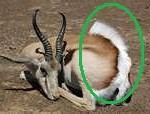
white pouch on the back
Springbok are known to survive without water for long periods. They get most of the water their body requires from the food they eat – soft green leaves, flowers and buds.
The springbok have been hunted for their meat, skins and horns for decades.
The springbok skins are in great demand as souvenirs, fancy articles and handbags!
More from Animals in Language
Python
python: a large python a kind of snake -- reptile -- usually large, muscular and powerful -- grows to 1 metre …
Animals-Adder-Aye-Aye
A B C D E F G H I J K L M N O P Q R S T …