


stork
[For the right pronunciation, please click here.]

a kind of bird – wading (= walks in the shallow water to find food) – large bird in different feather colours (mostly black and white), small cone-shaped head with a long, stout, straight beak (bill) (in some species the tip of the beak is slightly down curved), long, slender neck, large wide wings, long legs, medium-sized tail feathers; size 2½ -5 feet tall, 3-4½ feet long, and weight: 3-5 Kg; feeds on insects, fish, and small water animals, such as frogs, lizards, shellfish, water rats, small birds, ground-nesting bird eggs & chicks, and carrion (= the dead animals); lives for 25-30 years; about 19 species found mostly in northern hemisphere,
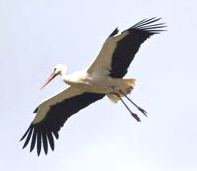
a stork in flight
female ~~ hen
baby ~~ chick
group ~~ mustering; flight
voice (call) ~~ {no voice – storks are dumb/silent} (some species make low ‘hissing’, ‘grunting’ or ‘whistling’ noises during nesting period) [but communicate through ‘beak (bill) clattering’ during mating season]
home ~~ nest (for laying eggs and raising the chicks)
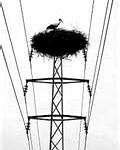
stork’s nest on a pylon
The ‘white stork’ is the national bird of Germany; Belarus, in Eastern Europe; and Lithuania, in Northern Europe.
The marabou stork has the widest wing span – 10 feet wide from the tip of one wing to the tip of the other wing when wings stretched!
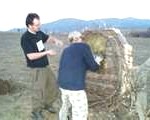
people making nest frames for the storks to build their nests in them
Once very common in parts of the world, storks now are only 160 thousands of in the world.
Storks are dumb; they cannot make calls as the other birds do. However, they make low ‘hissing’, ‘grunting’ or ‘whistling’ sounds during mating season, and they also communicate by ‘beak (bill) clattering’, i.e. a cock and a hen touch their beaks to show their love to each other by clicking and clattering . The clattering sound can be heard for a distance of more than ½ a mile!
Storks are popularly known for the habit of building their nests on rooftops, on tall chimneys of old houses, on pylons, and any tall structures, besides tall tree tops on the water edge! Each nest may be 6 feet in diameter and 10 feet deep, and may be used by the same pair of storks one year after the other for several years!
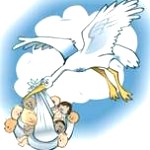
stork carrying babies (imaginary)
People used to build special places on their rooftops, keeping large cart wheels on the roofs, for the storks to build their nests on their houses because storks are believed to bring in good luck!!
Besides being associated with good luck, the storks have been symbols of fertility – associated with child-birth!!
In most ancient and medieval cultures of Europe and Middle-east Asia, people believed that storks were partly human and so could take human form, and some even believed that storks could bring dead people back to life!!
Storks have been hunted for their meat and feather. Stork feathers have been used in decorations.
Storks are found in literature, fables, folklore and in cartoons and films!
More from Animals in Language
Python
python: a large python a kind of snake -- reptile -- usually large, muscular and powerful -- grows to 1 metre …

Animals-Adder-Aye-Aye
A B C D E F G H I J K L M N O P Q R S T …