


swan
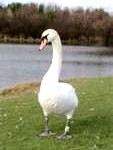
a swan on land
a kind of bird – water bird – related to the ducks and geese – large with (mostly) pure white feathers (some species have pure black feathers, and some others have black and white or brown feathers), small head with a flat duck-like beak (bill) with a knob on it, and found in different colours – black, yellow, orange, red, depending on the species, long, slender neck (curved elegantly in some species), bulky body, large wings, relatively short tail feathers, like that of a duck, short thick legs with webbed feet (= toes are joined with a thin skin layer, like that of a duck) [legs in different colours – black, grey, pink to red, depending on the species]; size: 4-6 feet long, and weight: 4-16 Kg. (‘coscoroba swan’ is the smallest – 3-4 feet in length and 4 Kg. in weight; and the ‘trumpeter swan’ is the largest, some of which can grow to 6 feet long, with a wingspan of 10 feet, and weigh 18 Kg.); feeds on (eats) mostly the plant matter in and around a water body, also (mostly young ones) small fish, insects, shellfish, etc; lives for, on average, 10-15 years (some individuals in some species live up to 35-40 years); 7 species found on most rivers, lakes, ponds and bays of the world
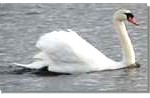
a graceful swimmer
female ~~ pen; swan
baby ~~ cygnet
group ~~ bevy, game, team, ballet, herd, lamentation; flock, wedge (in flight) voice
(call) ~~ {no particular name, but different species have different calls; some species are named after their calls} trumpet; whooper; whistle
home ~~ nest (to lay eggs and raise the chicks)
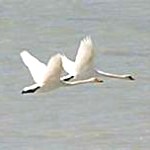
swans in flight
The ‘mute swan’ is the national bird of Denmark; the ‘whooper swan’ is the national bird of Finland; and the ‘black swan’ is the province bird of Western Australia, and the ‘Bewick’s swan’ is the province bird of Aomori province of Japan.
Swans are the largest of all water birds. some species of swans are migratory, i.e. they travel to distant places in order to escape the harsh winter weather, and fly back to the same place when season changes!
Swans are graceful birds. They are noted for their graceful movements while swimming. Some species of swans, e.g. the Australian black swan’ swim with only one leg, keeping the other leg tucked under the wing! The cygnets are known to do this from a very early stage!!
Swans are a symbol of love or fidelity.
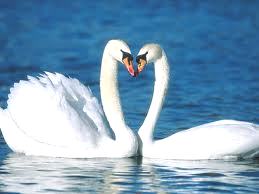
symbol of love
Swans are revered (almost worshipped) in many religions and cultures. In Hinduism, great spiritual leaders are addressed as ‘paramahansa’ (‘Hansa’ or ‘hamsa’ is the Sanskrit word for a swan.). According to the Hindu scriptures, the swan is the vehicle of several gods and goddesses, the goddess of speech and literature, Saraswathi, for example, and the Greek mythology is full of gods and goddesses riding swans!
Swans are so popular that they are depicted on the currency coins and postal stamps. They are the subject of many poems, ballet dances, musical compositions, and, of course, fairy tales and legends!!
Swans used to be the ornamental birds in the royal and public gardens, and have been kept in the zoos in several countries.
And they are found in several popular cartoons and motion pictures (films/movies) – the movie, ‘The Swan Princess’ (1994). On the other hand, the swan was one of the wild birds that were accused of carrying the avian flu (bird flu – H5N virus) that killed hundreds of people in the recent past!
1.
to swan (verb) =
(a) to go from place to place in search of food or job
(b) {southern US usage} to declare; to swear
2. to swan around/about = to wander (go) about places without purpose or purpose with an air of importance
3. black swan (noun) = unusual, peculiar, rarity, curiosity (before 18th century, people knew about only the white swan, but when the ‘black swan’ was discovered, people did not believe it and thought it was a rarity)
4. swan-neck [said of certain bends in pipes that look like swan’s neck]
5. swan song [said of some last work of art or performance of a prominent artist before his/her retirement or death; the last speech or remarks by a high-level official before his/her retirement from the job]
6. as graceful as a swan
For an article that explains what a swan neck deformity is, please click here.
More from Animals in Language
Python
python: a large python a kind of snake -- reptile -- usually large, muscular and powerful -- grows to 1 metre …
Animals-Adder-Aye-Aye
A B C D E F G H I J K L M N O P Q R S T …