


termite
(also called ‘white ant‘; for the right pronunciation of ‘termite’, please click here)
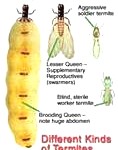
a kind of insect – wingless (some with wings during mating season) – soft body with a very thing exoskeleton (= tough outer cover) – looks like (resembles) an ant but more closely related to cockroaches —
Termites are well-organised social insects, living in large colonies, with a strict “caste” system: 1. queen or queens 2. king or kings 3. workers 4. soldiers 5. nymphs (young) & 6. re-productives.
1.queen:
‘Queens’ are ‘reproductive machines’. They are with wings at the initial stage. When the temperature is right, many of the queens from a colony fly into the air to mate. After finding a mate (king), they come down to the ground, lose their wings, and start a colony. They keep laying eggs all through their life – about 30,000 eggs a day! Though they do not move from place to place, they control the entire colony by sending ‘pheromones’ – a chemical substance sent out from its body!
Queens grow to a length of 1 inch, and they are darker than the others in the colony. They are so large that they cannot move. They are fed, cleaned and assisted by worker termites of the colony. Most queens live for 10 years, but in some species a queen may live for 25 years!
2.king:
The male termites are with wings in the initial stage. Many ‘kings’ from a colony fly into the air, along with the queens, when the time temperature is right and, after choosing a queen, they fall down to the ground, lose wings, and mate with one or more queens. They stay in the colony and do their prime duty — to mate with a queen or queens from time to time!
3.worker:
Workers are small in size and wingless and blind by birth – only 1/8 to 3/8 of an inch – but are in most numbers in a colony. The entire work is done by these workers. They find food, keep the nest clean, look after the queen and the king, keep the eggs and the babies clean, and feed the babies (nymphs). Though they are controlled by the queen, they are actually in charge of the colony! A worker ant may live for 1-4 years.
4.soldier:
Soldier termites are also wingless and the same size as the workers. Their body is more elongated with a large rectangular head and have sharp mandibles (jaws). Their prime duty is to guard their colony from predators! They die voluntarily when it comes to defending their nest!
5.nymph:
The young termites may grow into either queens, kings, workers or soldiers. At this stage, a termite has the ability to change its caste, i.e. it can be a queen if queens are few in number, or kings or workers, depending on the need!
6.re-productives:
These are a category of termites in a colony which can lay eggs and, at times, can participate in other activities, such as guarding the colony.
There two types of termites:
(A) = the one that lives entirely in wood –- there are again two categories in ‘wood’ termites: (a) dry wood termites (b) damp wood termites — the termites in this type are few in number, may be a few thousands in a colony, and once the piece of wood they live in is used up (eaten away), the entire colony dies
(B) the one that lives entirely in the ground – these are the most numerous and there can be thousands of millions of termites and the nest or mound keeps growing day after day!
The home of termites is called: on a tree or in a wooden structure, it is called a ‘nest’; and on land, it is called a ‘mound’, ‘anthill’ or ‘termitarium’ (plural – ‘termitaria’).
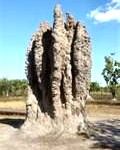
(a termite mound above ground)
There are about 4,000 species found all over the world, except, of course, the coldest parts!
Termites build nests or mounds or hills. Their bodies are so soft and their exoskeletons are so delicate that they need to be moist all the time. Therefore, the ‘wood termites’ build ‘mud tunnels’ for them to move from one place to another.

(a wood termite nest on a tree)
Termites feed on mostly dead plant matter — wood; besides, they feed on animal dung, leather goods, wall paper, books, thatch roof, carpets, wooden poles, and electric and telephone cables!!
Though the termites are a staple food for many animals – anteaters, birds, etc., they are a terrible pest. They damage (eat away) crops, plants, trees and even man-made structures. As they are very secretive and live inside the wood they eat away, they are difficult to find immediately when they colonise the place.
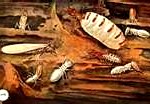
termites damaging wood
However, it is interesting to know that people in some societies relish termites, and lions and gorillas also find termites tasty!!
Some animal experts are in the opinion that the termites are useful in a way. They eat away the dead plants and send out the waste matter from their bodies into the soil again, which process helps the soil to get enriched with the plant matter from time to time!!
It has been found out that termites can produce two litres of hydrogen from digesting a single sheet of paper! And basing on this recent amazing find, some scientists are working hard on how to use this ability to our advantage in producing a non-fossil and non-pollutant substitute for present fossil fuel!
termite (noun) = a destructive, dangerous person to the society
More from Animals in Language
Python
python: a large python a kind of snake -- reptile -- usually large, muscular and powerful -- grows to 1 metre …
Animals-Adder-Aye-Aye
A B C D E F G H I J K L M N O P Q R S T …