


tsetse fly
(also called ‘tik-tik fly’ & spelled ‘tzetze fly’ or ‘tsetze’; plural – ‘tsetse flies’; pronunciation: ‘set-see’ or ‘teet-see’ — for the two different pronunciations, please click here)
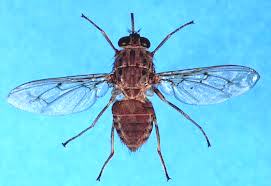
a kind of insect – biting and blood-sucking – belongs to the ‘true fly’ family – larger than the common house fly with body in three parts, only 2 wings, six legs, and a long proboscis (= long tube –like mouth part) attached to a bulb on the front of the head; size: ¼ — ½ an inch long, and weight: —; feeds on (drinks) the blood of animals, including people; lives for 3-6 months (on average 1½ months), some species live for years; about 34 species and sub-species, found in parts of Africa

tsetse fly sucking blood
Tsetse flies are biting and blood-sucking flies. They are a very dangerous disease carrying insects. They are very difficult to eradicate.
Unlike in most flies in which only the female bites and sucks blood, both the male and female tsetse flies bite and suck blood!
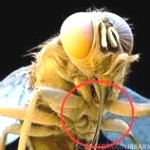
long proboscis to suck up blood
Tsetse flies carry single-celled organisms which cause a serious, infectious disease called, in humans, ‘sleeping sickness’, and, in cattle, horses and pigs, ‘nagana’!
The reproductive system is also very different in tsetse flies: the adults mate only once, but the female gives birth to 10 offspring – one after the other – in some species a female produces about 30 generations in its long lifespan.
The female lays one egg each time, but keeps the egg in its abdomen; the egg hatches into a maggot and grows in its mother’s abdomen; when the maggot is big enough, the female releases it in the soil where it pupates, and after several changes, it becomes an adult tsetse fly!
More from Animals in Language
Python
python: a large python a kind of snake -- reptile -- usually large, muscular and powerful -- grows to 1 metre …
Animals-Adder-Aye-Aye
A B C D E F G H I J K L M N O P Q R S T …