


turkey
(plural – ‘turkeys’)

male & female turkeys
a kind of bird – ground-living – diurnal (= active during day) – related to the grouse and belongs to the pheasant bird family – large with different coloured feathers depending on the species and sub-species, bare head and neck (no feathers on head and neck), fleshy growth on the head called ‘carbuncle’, long finger-like growth of flesh that hangs loose from the upper base of the beak (bill), called ‘snood’, fleshy loose skin fold that hangs from the underside of the beak and on the neck, called ‘wattle’, cone shaped head with round clear eyes, short, sharp beak (bill), stocky body, long wings, strong, relatively long legs with four toes with claws on each foot and a sharp 1 inch-long spur on the back of the leg, long, wide tail feathers in different colours in males, which can be spread like a fan;
They are: 1. wild turkey 2. ocellated turkey 3. domesticated turkey.
1.
wild turkey:
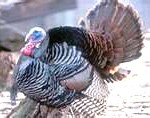
wild turkey
Wild turkeys are found in the forests of North America. They have featherless reddish head and neck (the colour changes to grey, blue, depending on the emotions of the bird; females have feathers on their necks),
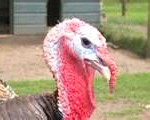
turkey’s head
the head has a fleshy growth called ‘caruncle’, a finger-like 1-5 inch-long fleshy growth that hangs loose from the base of the upper beak (bill), bumpy flesh growth hanging loose from the base of the lower beak and the throat, called ‘wattle’,

a tuft of feathers
and males (also 10-15% of the females) have “beards”, a 9 inch-long hair-like tuft of feathers sticking out from the breast, dark body feathers, short, rounded wings, relatively long but strong legs with four toes and one 1-inch-long spur at the back of the legs, long, flat tail with different coloured feathers, which can be spread out like a fan, like that of a peacock’s but shorter and less ornamental; size: 2½-4 feet in length and 3-11 Kg. in weight (males larger than females); feeds on (eats) nuts, fruit, seeds, leaves, buds, and occasionally, insects, worms, snails; lives for 10-13 years; several sub-species, found in the forest areas of North America
female ~~ hen, jen; jenny (immature)
baby ~~ chick; poult
group ~~ rafter, posse, gang, dole, raffle; gobble, flock {Some authorities consider ‘gobble’ and ‘flock’ as group names for turkeys wrong!}
voice ~~ gobble, cluck, putt, purr, yelp, cut, whine, cockle
home ~~ nest (on the ground – for laying eggs only)
motion ~~ strut (males, during mating season)
The ‘wild turkey’ is the state bird of Alabama and Massachusetts, USA.
Wild turkeys are native to North America, and they are a popular food and game bird!
Wild turkeys can fly well. Though they spend most of their time on the ground, they spend their night time in trees. However, when alarmed or chased, the wild turkeys prefer to run away and escape rather than fly away!!
Turkeys have been eaten traditionally on special occasions in the United States!
2.
ocellated turkey:
(also called ‘Petén turkey)
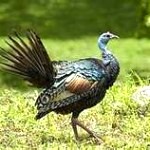
Ocellated turkeys are almost similar to the ‘wild turkeys’ but smaller in size and weight, and do not have the ‘beard’, the tuft of feather-like hair sticking from the breast. They have slender-looking bodies with a little variation of the feather colours; found in Mexico.
The ocellated turkey was very important to the ancient Aztecs as a source of food, and the feathers were used for decoration!
3.
domesticated turkey:

a white domesticated turkey
All the present domesticated turkeys descended from the ‘wild turkey’ of North America. They are larger than the ‘wild turkey’ and the ‘ocellated turkey’. A male may measure 4 feet long and 4 feet tall, and weigh 35 Kg. (male larger than female). Now found all over the world.
female ~~ hen, jen; jenny (immature)
baby ~~ chick; poult
group ~~ rafter, posse, gang, dole, raffle, dole; gobble, flock {Some authorities consider ‘gobble’ and ‘flock’ as group names for turkeys wrong!}
voice ~~ gobble, cluck, putt, purr, yelp, cut, whine, cockle
home ~~ nest (on the ground – for laying eggs only)
motion ~~ strut (males, during mating season)
The meat of the turkey bird eaten by people is also called ‘turkey’.
The domesticated turkey is a popular food and game bird in the United States. [It is estimated that on average an American eats 9 kg. of turkey a year!]
In fact, it is believed that Benjamin Franklin, one of the founding fathers of the USA, wanted ‘turkey’ to be the national bird of the USA! [The national bird of the USA is the ‘bald eagle’.]
These birds are eaten on special occasions, such as ‘Thanksgiving’, ‘Christmas’ and ‘Easter’, etc.; besides, their meat is used in other fast-food items!
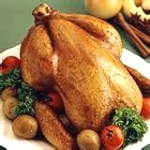
(Easter turkey)
On Thanksgiving Day – 45 million turkeys; at Christmas – 22 million turkeys and on Easter – 19 million turkeys are eaten every year in the USA!!
It is surprising to know that the fist men on moon, Neil Armstrong and Edwin Aldrin, ate ‘roasted turkey’ in the foil packs as their first meal on the moon!
To meet this great demand, turkeys are raised on large farms, and like the battery chicken, their original beautiful colour feathers are changed into white!
On the farms, the domesticated turkeys are over-fed, and, consequently, they grow so heavy that they cannot fly!! The male turkeys do not know how to mate or, even if they knew how, they could not mate because they are so out of proportions, and so, the female turkeys are artificially inseminated (= giving medicine to make them lay eggs)!!
The domesticated turkeys do not seem to know what ‘danger’ is, and they do not know how to get out of rain; they just stay where they are, waiting to be fed, and if the feed is not given or there is no one to look after them, they just die of starvation or from the danger!
The skins of turkeys are tanned and made into leather goods, such as cowboy boots, belts, bags, etc!
The bird turkey has nothing to do with the country Turkey. The Spanish conquerors long ago, took back some turkey birds from Central America (Mexico) to Europe, and when the English settlers in America saw these birds, they thought those were the same birds they had seen in Europe, which they used to think were from the country Turkey in Eurasia!
1.
turkey (noun) =
(a) a foolish and slow-thinking person
(b) an unexpected interest
(c) a failure (a failed play (drama) or movie/film)
(d) three consecutive (= one after the other without gap or break) strikes in bowling game
2.
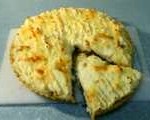
(Irish turkey)
Irish turkey = a food item (corned beef and cabbage)
3.
(a) cold turkey
(b) to go cold turkey
= the method of curing ‘drug addiction’ by suddenly stopping any more doses of that drug; the unpleasant feeling the ‘drug addicts’ experience when they suddenly stop taking that drug
4.
sookin’-turkey = a childish person
5.
turkey shoot = something that is very easy
6.
to turkey-tail = to spread out or fan out, like the tail feathers of a turkey bird
7.
as innocent as a sooking turkey
8.
to talk turkey = to talk agreeably; to talk frankly and bluntly; to get to business
9.
to take cold turkey = to yield (= given in) to someone and withdraw suddenly and completely
10.
(he is) driving turkeys to market [said of someone who cannot walk straight]
11.
a turkey never voted for an early Christmas [said to imply that people do not choose what is not to their advantage]
12.
turkey hung with sausages [said of a mayor or alderman wearing his chain of office]
More from Animals in Language
Python
python: a large python a kind of snake -- reptile -- usually large, muscular and powerful -- grows to 1 metre …
Animals-Adder-Aye-Aye
A B C D E F G H I J K L M N O P Q R S T …