


turtle
(also called ‘sea turtle’; for the right pronunciation of turtle, please click here)
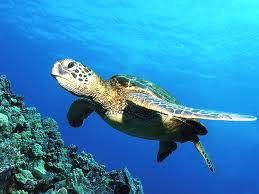
a turtle in the sea
a kind of animal – reptile (= animal that creeps on land;) – four-legged – omnivore (= eating both plant matter and other small animals) – egg-laying – diurnal (= active during day) – slowing moving – cold-blooded (= the body temperature changes depending on the weather condition; the present/scientific name ‘echtothermic’) different colours with endo- and exoskeleton – different patterns on the upper flat shell called ‘carapace’ and the flat lower shell called ‘plastron’, the body attached to the carapace, relatively small, flat, cone-shaped head with a beak-like mouth, no teeth, a tongue but cannot stick out, front legs changed into flippers with few claws, flat back legs, and covered in scales, long, pointed tail; size: (varies widely) from 2 to 5 feet long, and weight: (varies widely) from 25 to 650 Kg (individual record being 920 Kg.); feeds on (eats) weeds, moss, fungi, and worms, insects and small fish and shellfish; lives for, on average, 80-100 years; about 7 species (kinds), found in almost all the oceans of the world, except in polar regions
female ~~ female
baby ~~ hatchling
group ~~ bale, bevy, nest, dule, turn
voice (call) ~~ —-
home ~~ nest (only for laying eggs, in a hole in the sands of beaches); arribada (the behaviour of many females nesting at the same time at the same place)
The ‘turtle’ is the state reptile of several states in the USA: western painted turtle – Colorado; painted turtle – Illinois and Michigan; ornate box turtle (not ‘true turtle’) – Kansas; Blanding’s turtle – Minnesota; three-toed box turtle (not ‘true turtle’) – Missouri; common snapping turtle (not ‘true turtle’) – New York; eastern box turtle (not ‘true turtle’) – Tennessee, North Carolina ; and loggerhead sea turtle – South Carolina.
soft outer shell
Turtles have two skeletons: endoskeleton and exoskeleton. The two skeletons are attached on the back so that, unlike other shell-bearing animals, tutles cannot get out of their carapace; and unlike the tortoises or ‘land turtles’, they cannot draw back their head, legs and tail into the protection of the shells when attacked by enemies or predators!
Turtles, along with the ‘tortoises’, have been hunted for their meat and the shell (carapace) for thousands of years!
The meat of the sea turtles, along with the ‘land turtles, has been eaten by people for centuries. The meat has been eaten world wide, and the skin of the sea turtle flippers has been made into leather and used in making leather goods!
The carapaces of the turtles, along with the tortoises or ‘land turtles’, have been used for decoration purposes – masks, table clocks, art items, frames for eye-glasses, etc., since ages!

(a turtle’s carapace as decorative item)
{Most of the so called ‘tortoiseshells’ used in traditional decorative, ornamental material are believed to be from the “hawksbill sea turtles”!}
The sea turtles were associated with several ancient civilisations. They were worshipped in some cultures and were mentioned in scriptures, myths and in traditional art!
The bony plates of the sea turtle, known as ‘scutes’, were used by ancient Greeks and Romans!
The ‘leatherback’ is the only sea turtle that does not have a hard shell, carapace. However, it has bony plates beneath its leathery skin.
In addition, leatherbacks are the largest of all the sea turtles – 6-7 feet in length, 3-5 feet in width, and 650 Kg. in weight. The Kemp’s Ridley turtles are the smallest of all the sea turtles – 2½-3 feet long and weight: 35-50 Kg.

turtle tracks on a beach
Though sea turtles mate in water, the female sea turtles lay eggs on the sandy beaches. They crawl on to the beaches, find a suitable spot, dig a deep hole with their hind legs, lay eggs, fill up the hole and crawl back into the sea! There is no parental care at all; the young turtles dig themselves up from the nest, and hurriedly crawl to the water and with the help of the waves, swim away into the sea, if they survive the numerous predators on the beach waiting for them to come out!
It is surprising to learn that the female sea turtles go to the same breeding beaches where they were born; and an individual female uses the same area of the beach year after year!!
The “Teenage mutant ninja turtles” is a popular comic serial, and has been successfully made into animated films and toys!
1. turtle (noun) =

(turtle-neck sweater)
(a) a woman considered as a sex object
(b) a turtledove, a kind of bird
(c) a turtleneck, a kind of sweater with a high, round neck that is rolled up to cover the neck and throat ofthe wearer
2. turtle-back = a hump or a small hill
3.

(a car turned turtle)
to turn turtle =
(a) to come to sorrow
(b) (of a vehicle – a boat, a motor car, etc.) to turn upside down accidentally
4. to take off like a herd of turtles [said ironically of some plan, project, etc., that is not get started; of a hopeless plan or venture; to be in confusion]
More from Animals in Language
Python
python: a large python a kind of snake -- reptile -- usually large, muscular and powerful -- grows to 1 metre …
Animals-Adder-Aye-Aye
A B C D E F G H I J K L M N O P Q R S T …