


wapiti
[For the right pronunciation, please click here.]
(also ‘elk’ or ‘American elk’)
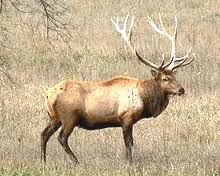
a kind of animal – mammal – related to deer – large four-legged, grass-eating, large with brown or light brown on the upper side and dark under side and legs, a white patch on the back part (rump), with males having antlers (not ‘horns’) which drop off (shed) every year; grows to 4-5 feet at the shoulder and 6-8 feet long, and weighs 225-300 Kg.; feeds on (eats) grass, plants, leaves and bark of certain trees; lives for 10-26 years (different authorities give different figures); originally from North America and eastern Asia, but introduced into New Zealand and Argentina
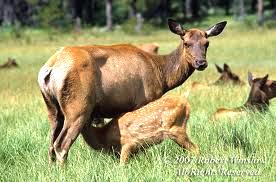
cow & calf
female ~~ {in America} cow, {in Asia} hind
baby ~~ {in America} calf, {in Asia} fawn
group ~~ gang; herd
voice (call) ~~ bark; bugle; whistle; (squeal and bellow (?))
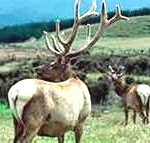
white rump & tail
Wapiti are hunted for sport, meat, antlers and skin. Wapiti have white patches on their back part (rump), and a short white tail. The male (bull) wapiti have antlers (not horns which stay permanently in ‘antelope’) which they drop off (shed) every year and grow them again during the mating season!

beautiful antlers
These antlers grow to 4 feet long and weigh up to18 Kg. The wapiti antlers and velvet (the smooth velvet cloth-like covering on the antlers at one stage of their growth) are used in traditional medicine in Asia. The antlers and the velvet are believed to have medicinal qualities that improve sexual desires, which is baseless and disproved, too. The antlers are kept as trophies!!
More from Animals in Language
Python
python: a large python a kind of snake -- reptile -- usually large, muscular and powerful -- grows to 1 metre …

Animals-Adder-Aye-Aye
A B C D E F G H I J K L M N O P Q R S T …