


conch
(plural – ‘conchs‘ or ‘conches’)
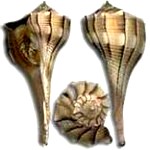
a kind of sea animal – sea water mollusc – shell snail– with a soft body, long eye-stalks, a foot-like organ for digging and moving, with a hard brightly coloured single spiral shell (also called ‘conch’); different species (kinds) grow to different sizes – on average, about 7-12 inches (some can grow to 24 inches) long and weighs 500 grams to 2 Kg. (some species can be very small and some, very large); feeds on water plant matter, algae, clams, and dead animals; lives for 20-25 years; found mostly in the tropical (warm) salt waters of the world,

more popular kind of conch
The name ‘conch’ is also given as a general name to any mono-value (single shell) shellfish which are not “true conches”. The shell of the conch is also called ‘conch’.
Compare: whelk
 The live conches are cooked and eaten as food.
Few kinds of conches are capable of producing pearls, like oysters.
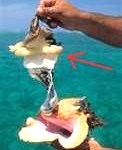
the soft conch pulled out from the shell
The brightly coloured spiral shaped conches (shells) are used as wind instrument (music instrument), like a trumpet; and also used as ornaments, and for decoration; or they are just valued and kept as a collector’s item.
Conches (shells) have been in the scriptures of several ancient cultures: they were blown to announce the beginning of a religious ritual or a battle, etc., in Hindu religion – several of the Hindu gods are seen carrying conches in their hands; Buddhists monks blow them to announce some important religious occasion; and the ancient civilisations of South America were very familiar with the use of the conch which is seen in their art even to this day.
The most surprising thing is that, in the modern music world, several famous music composers have used the conch in their music compositions!
More from Animals in Language
Python
python: a large python a kind of snake -- reptile -- usually large, muscular and powerful -- grows to 1 metre …

Animals-Adder-Aye-Aye
A B C D E F G H I J K L M N O P Q R S T …