


kiwi
[For the right pronunciation, please click here.]
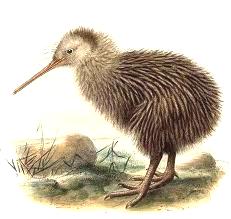
a kiwi
a kind of bird – flightless bird (= cannot fly) – related to ostrich and emu — belongs to ratites – small for a flightless bird – round body with coarse (rough) bristly hair-like feathers in different colours, depending on the species, very short wings, no tail feathers, small round head with small eyes, long straight (6 inch long) beak (bill), short stubby legs with sharp three-toed feet, size: from 10 inches to1½ feet long, and weighs 1-3 Kg. (female larger than male); feeds on (eats) seeds, fruit, grub (insect larvae), insects, worms, frogs, snails, crayfish, and eels; lives for 20 years; 5 species (kinds) native only to New Zealand, found in zoos, and recently, some other parts of the world,

a kiwi on a postal stamp
female ~~ female
baby ~~ chick
group ~~ —
voice (call) – {no specific name, the sounds like ‘kee-wee …kee-wee’}
home ~~ burrow (dug by the kiwi)
The ‘brown kiwi’ (bird) is the national bird of New Zealand; and is found on the logos of many schools, offices and organisations, and the military departments!
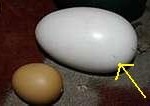
a kiwi egg (white) with a chicken egg (brown)
The ‘kiwi’ bird is so much a part of New Zealand that it is synonymous with New Zealand: New Zealand is kiwi bird and kiwi bird is New Zealand or New Lander, including the military personnel and the sports-persons!
The picture of a kiwi is found on the state postal stamps, coins, emblems, and on the commercial products, in the shop names, and everywhere else!!
The kiwi’s name is onomatopoeic, i.e. it is given the name after its call which roughly sounds like ‘kee-wee…kee-wee’.

smelling for insects with its ‘nose’
The native New Zealanders have been using kiwi bird’s feathers in making cloaks (‘cloak’ = long loose outer coat-like garment).
The kiwi is the smallest of all the flightless birds; however, it lays the largest egg in comparison to the female’s body size:
Kiwi are one of the very few birds that dig burrows to live in!a female kiwi is only as big as a domestic chicken (hen), but its egg is six times as big as a domestic chicken’s egg!
It has been observed that a pair of kiwi birds mates for life, i.e. once a male and a female mate, they stay together, producing eggs year after year.
The most interesting feature of a kiwi bird is its nose: a kiwi has a long beak (bill) with the nostrils (= nose holes) at the end of the beak, not at the base!!
(kiwi shoe polish)
Kiwi have a highly developed sense of smell which is a rare feature among birds. A kiwi uses its nose to ‘smell’ the insects or worms that are underground before it sees them. There are bristles (whiskers), stiff thick hair around the base of the beak (bill), with which it can feel the things around in the dark.
Though kiwi cannot fly; they can walk very fast, can easily outrun a person in the bushes. They walk as if they were rolling!
The world famous ‘kiwi shoe polish’, which was first produced in 1906, is, ironically, not the product of New Zealand! It was first produced by an Australia-based Scottish gentleman whose wife was a New Zealander, and in honour of his wife he named his product ‘kiwi’!!

(kiwi fruit)
More from Animals in Language
Python
python: a large python a kind of snake -- reptile -- usually large, muscular and powerful -- grows to 1 metre …
Animals-Adder-Aye-Aye
A B C D E F G H I J K L M N O P Q R S T …