

lama:
(plural: ‘lamas‘; for the right pronunciation, please click here)
(without a capital ‘L’) a high-level Buddhist priest or monk of Tibet and Mongolia;
a priest or monk of Lamaism,
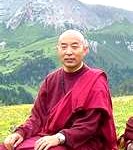
a Buddhist lama
A Buddhist monk is a Buddhist man who has given up physical desires and taken to spiritualism, but a Buddhist lama, called ‘tuluku‘ in , is a spiritual guru, a rebirth of a previous teacher, who can teach the Dharma.
The monks or existing lamas of a Buddhist monastery often chose some young boys whom they think are the incarnations of previous lamas and train them to be future lamas.
Before the Chinese invasion of Tibet, there used to be thousands of lamas teaching the essence of Buddhism, but now it is estimated that there are just over five hundred lamas, most of them doing their job of teaching Buddhism in hiding.
As there is a change in most religions and religious leaders in the world, there is a shift in the ideologies in Buddhism, too, and more and more ‘lamas’, monks or young boys who are chosen to be the next generation of spiritual leaders/teachers, refuse to be spiritual and prefer to lead normal lives!
However, as the word ‘lama’ is also used to refer to a Buddhist monk, it is also found in the names of Buddhist men as a title to distinguish them from ordinary (lay) Buddhist men, e.g. Lama Gyurme is a Buddhist monk famous for his music talents.
Note 2: The word ‘Llama‘, with a double ‘l’ but with the same pronunciation, is the name of an animal found in the mountainous regions of South America. However, ‘lama’, with a single ‘l’ but in capital letter (upper case) ‘L’, is found in the scientific name of this and another of the same kind of animal, Lama glama & Lama guanicoe, and as a general name (genus) for some types of ‘camel’ — llama, alpacas, guanaco and vicuña — found in South America.