


lamprey
(also ‘lamprey eel’; plural – lampreys; for the right pronunciation, please click here)

a lamprey
a kind of fish – jawless, scale-less, finless, bone-less (but cartilaginous = bone-like substance), long round eel-like body grey-blue back, metallic violet sides and silver-white under-side; large eyes, suction like mouth with several sharp teeth and sharp bony tongue, 7 gill slits on each side just below the eyes, only one nose hole (nostril) on the top of the head; size: anywhere from 5 inches to 3½ feet long, and weighs anywhere from 40 grams to 400 grams; feeds on the blood of other fish (parasite); the life-cycle: 5-8 years (or 10 years); two broad types: ‘sea lamprey’ and ‘fresh-water lamprey’, with about 40 species found in the seas and rivers all over, mostly in Europe and America, except Africa

a lamprey attached itself to a big fish
Sea lampreys are like salmon and alewife fish: they begin their life as larvae in fresh water; spend their larval stage (as long as 7 years) in the mud at the bottom of the river or lake, undergoing several changes; start the journey back to the sea; and once reaching the breeding adult stage, returns to fresh water to spawn, and after spawning (laying eggs), they die!
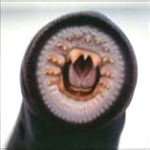
sharp teeth
Lampreys are parasites, i.e. they do not hunt but take the blood of other animals directly by attaching themselves to the other larger fish with their several sharp teeth in their oval-shaped suction-cup-like mouth and boring a hole in the prey with their sharp bone-like tongue!
Lampreys are the ‘vampires of the fish world’!
More from Animals in Language
Python
python: a large python a kind of snake -- reptile -- usually large, muscular and powerful -- grows to 1 metre …
Animals-Adder-Aye-Aye
A B C D E F G H I J K L M N O P Q R S T …