


leech
[For the right pronunciation, please click here.]

a leech
a kind of animal – invertebrate (= soft body without backbone and bones) – parasite (= an animal that lives on or in the body of other animals by taking the digested food or blood directly, instead of hunting) related to earthworm –- small with tube-like 34 segmented (= compartmental or ringed) body, pale brown or grey or black in colour (some species with different colours), a mouth opening on either end; compound eyes on one end; size: ¼ of an inch to1 foot long (commonly 3-6 inches); feeds on (eats) the blood and body fluids of other animals, such as fish, frogs, other worms, snails, lizards and mammals, including people; lives for about10 years; 650 species (kinds) found throughout the world
(A)
Kinds of leeches depending on the habitat (= the place they live):
(1) fresh-water leeches – ponds, lakes, rivers
(2) land leeches – wet and warm areas
(3) marine leeches – seas and oceans
(B)
kinds of leeches depending on the feeding methods (physical structure):
(1)
jawed leeches – 3 or 2 jaws in each of the oral sucker with sharp teeth in the mouth opening with which they attach themselves to the prey (= the animal which they feed on), make a wound (= an opening) in the body of the prey, and with the strong muscles suck the blood
(2)
jawless leeches –
(a) no jaws or teeth but have a proboscis (= a small tube-like organ, like a straw) with which they suck the blood
(b) no jaws, teeth or proboscis, but have a large mouth with which they swallow their prey whole
Everything about a leech is fascinating:
*the oral suckers (= openings on both ends) are used for feeding, reproduction and moving;
*only the jawed leeches can swim; though the other kinds live most of their lives in water, they sink to the bottom and stay there curled up
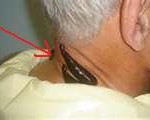
leech therapy — blood letting
*the ‘giant Americobdell leech’ from southern Chile feeds on large earthworm which it swallows whole
**some species of leech look after their young providing food and protection which, the experts believe, is an unusual behaviour in invertebrates (soft body animals without back-bone or other bones)
*in the past, for 2500 years, leeches were needlessly used in medical treatment – some barbers and physicians used the ‘medicinal leech’ to drain the blood of a sick person, (the treatment is called ‘bloodletting’), with the blind belief that when the bad blood was drained off, by letting the leeches suck out, a patient would get better

(a wound made by a leech)
**however, leeches are being used in the present day advanced medical science – in scientific research and plastic and reconstructive surgery, because leeches produce some kinds of fluids which make their bite painless and keep the blood of the prey from clotting (= getting thick so that more blood does not come out of the wound or hole they make); a new type of medical treatment for certain heart and brain diseases, called ‘leech therapy’, is gradually becoming popular in the developed countries; only 15 of the 650 species of leech are used for medicinal purpose
**finally, the more experienced victims advise the inexperienced victims to let the leech suck the blood, which process takes about 20-40 minutes, and drop off on its own, instead of trying to pull it off or using some less successful methods of getting rid of it, like using leech repellents or even burning them with lit cigarettes, when a leech catches them unaware!!
1. leech (noun) = (a) a person who continually makes profit out of another
(b) a person who depends on another person, and gets favours all the time
(c) {old usage} a doctor; a physician
2. to leech (verb) = (a) to drain (= use up) the resources of…
(b) to attach oneself to another in the manner of a leech to get favours, help or money
3. to stick like a leech = to attach oneself to another like a leech
4. fastened on like a clemmed leech (‘clemmed’, in this context = starved; not having food)
5. to cling like a leech = to attach oneself to another and not willing to be separated from
For some more interesting facts about leeches, please click here.
Return to “lamprey” in Animals in Language. Return to “leach ~ leech” in Words Often Confused.
More from Animals in Language
Python
python: a large python a kind of snake -- reptile -- usually large, muscular and powerful -- grows to 1 metre …
Animals-Adder-Aye-Aye
A B C D E F G H I J K L M N O P Q R S T …