


lobster
[For the right pronunciation, please click here.]
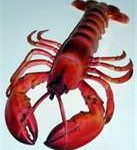
a lobster
a kind of animal – salt-water crustacean (= animals that include crabs, crayfish, shrimp, krill and barnacles) – cold-blooded (= the body temperature depends on the temperature of the water – ‘cold-blooded’ is the old name, the advanced name is ‘ectothermic’ or ‘ectothems’) –- long thick body without a backbone or other bones, but with a hard covering called ‘exoskeleton’, ten pairs of legs of which the first pair develops into large claws, the other four pairs for walking, feeding and mating; flat, fan-like tail part, head and middle part of the body joined and covered with a tougher covering, two long antennae and two small antennae, eyes on stalks (= small finger-like growth that can be moved, on which the eyes are placed), different colours of the body: blue, green, purple and yellow; size: adults anywhere between 9 inches and 4 feet long, weight: 500-900 grams (some individuals can weigh up to 20 Kg.); feeds on (eats) fish, clams, crabs, worms, some other lobsters and (some kinds) plant matter; lives for about 50 years (some individuals are known to live for 100 years); about 30 (?) species (kinds) found in the salt waters of the world,
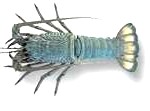
a blue lobster is not a true lobster; it’s a blue crayfish
female ~~ hen
baby ~~ cricket (?)
group ~~ risk, ( ??? ‘pod’, ‘deck’, ‘shield’, and ‘box’ if several bought from a store)
voice (call) ~~ —
home ~~ burrow
The meat of a lobster eaten by people is also called ‘lobster’.
Lobsters are one of the main seafood sources; millions of dollars’ worth of lobsters are marketed each year!
Lobsters are called the ‘cockroaches/roaches of the sea’, for their habit of eating anything, just like cockroaches that eat anything and everything!
The lobster’s blood is colourless, but when exposed to oxygen it turns to blue or grey!

cooked lobster
Lobsters are of different colours; but when cooked they all turn red!
Lobsters have very good sense of smell, and they can also communicate through chemicals.
Lobsters do not live in groups, but like to be alone. A lobster meets another lobster only during mating. If several lobsters are forced to stay in groups in a small place, they eat one another. They tend to be cannibals in confined places!!
Lobsters can regenerate some of their body parts, i.e. they can grow cut off or damaged legs again. In fact, they drop off (shed) their claws or legs to distract their predators (= animals that try to kill and eat them). Lobsters are able to use their mouth not only for eating but also for making burrows, moving small pebbles out of the way, and for turning themselves, especially when their claws or legs are cut off!
A lobster does not have its teeth in its mouth, but has them in its stomach!
Lobsters have short hairs (bristles) on its body, which are called “hedgehog hair” with which they feel the things around!!
A recent research shows that lobsters do not show signs of aging; instead, the older a lobster grows, the more fertile it becomes. Though they die of other causes, such as disease, eaten by other animals, etc., they don’t die of old age as most of the other animals, including humans, do. For an article about this phenomenon, please click here. This finding, however, has become controversial as some scientists oppose it seriously, questioning why, if that’s the case, the oldest lobster’s age is recorded as 140, and some support it.
Three other animal names are associated with a lobster: 1. the baby is called a ‘cricket’ 2. half a kg. lobster is called a ‘chicken’; and 3. the hair on the lobster is called ‘hedgehog hair’!!!
1. lobster (noun) =
(a) an awkward, silly or foolish person
(b) {Australian informal usage} a currency note worth of $ 20
2. raw (uncooked) lobster = a seaman or police in blue uniform
3. cobbler’s lobster = cow-heel – the foot of a cow cooked as food (‘cobbler’ = a person who makes and/or repairs shoes)
4. lobster-eyed [said of someone with eyes projecting out (protruding eyes)]
5. as dead as a red lobster
6. as red as a lobster
7. he has boiled his lobster [said of a man who has left the religious life and joined the armed forces (military)]
For an informative article that tell us about the main differences between a lobster and a crayfish, please click here.
Return to “crayfish“.
More from Animals in Language
Python
python: a large python a kind of snake -- reptile -- usually large, muscular and powerful -- grows to 1 metre …
Animals-Adder-Aye-Aye
A B C D E F G H I J K L M N O P Q R S T …