


octopus
(also called ‘devil fish’; plural: ‘octopuses’, ‘octopi’ or ‘octopodes’ — for the right pronunciation of octopus, please click here)
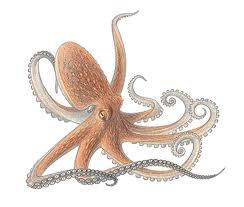
a kind of animal – salt-water mollusc – no bones or inside or outside hard shell covers – soft body covered by a substance called ‘mantle’, with a globe-shaped head in which all the important organs are placed – two large eyes on the top of the head, a mouth in the centre of the under side of the head, with a parrot-like beak (bill) and a tongue, eight long pointed same length arms growing directly from the base of the head in different directions – each arm with one or two rows of sucker cups running along the underside; size: varies widely – from 1-2 inch wide (measured from the tip of one stretched arm to the tip of the opposite arm) and only 1-2 grams in weight to 10-16 feet wide (some species can grow up to 60-65 feet wide, and weigh 250 Kg.), and 10-50 Kg in weight; feeds on snails, clams, mussels, fish, and other small octopuses; lives for 2-5 years in the wild; about160- 289 (?) species found in all the temperate and tropical seas and oceans of the world,
female ~~ hen
baby ~~ larva
group ~~ octopi (?)
voice (call) ~~ —
home ~~ den; lair (small slits or holes or gaps in the rocks of the sea bottom)
movement ~~ crawl; swim; {and uses ‘jet propulsion’ for fast movement}
The word ‘octopus’ means “eight feet” – ‘octo’ = eight & ‘pus’ = foot. However, the eight long organs of an octopus are called ‘arms’, but not ‘feet’ or ‘tentacles’.
Octopuses are without fins, but there are some species which live in deep levels of sea that have fins with which they balance themselves and swim.
Animal experts say that the octopus is the most intelligent of all invertebrates (= animals without backbone)! It has a good sense of sight and excellent sense of touch, but it is known to be deaf!
Octopuses are said to be incredible escapists – they can squeeze in through the smallest hole or slit, because they have no bones or any other hard substance, except the parrot-like beak (bill) in their body; excellent camouflage experts – can change not only the colour but also the shape to suit the surroundings and to mimic the more aggressive animals, like the sea snake or weird looking leafy dragon, or some water plant, etc., to escape from predators (= animals that try to kill and eat them)!
The octopuses are known to have the ability to learn – they can open the caps of jars, can recognise shapes, and can find a way out in a maze!!
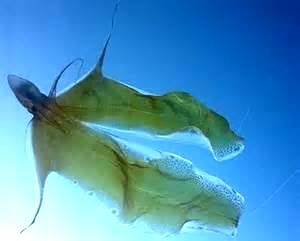
a female blanket octopus
Octopuses are a food source, and the whole octopus or the arms eaten as food by people is also called “octopus”. Octopuses are also kept as pets, and used as bait to catch large fish. {Some people eat the smaller kinds of octopuses live – without cooking!}
Though the standard number of arms of an octopus is ‘eight’, they are some individual octopuses that are with six, seven or nine arms!
The octopus is one the few animals whose blood is not red, but blue… a bluish colour that, according to scientists, helps the octopus survive in cold regions where temperatures reach below 0 degrees! For an article that explains why octopus blood is blue and how it helps the octopus, please click here.
It is also one of the few animals which die after mating and laying eggs: the male octopus passes its sperm, wrapped in a sperm sac, into the female with the help of one of its arms, by breaking the arm off from its body while passing, and dies after a few days; the female keeps the sperm until the eggs are ready, squeezes the sperm sac on the eggs, like we squeeze the tooth-paste on the tooth-brush, and once the eggs fertilise, it lays them attached to the roof of its den and then guards the eggs until they are hatched, and dies soon after!!
Though the octopus uses all or some of its arms while crawling, there are some species of octopus which can walk or even run on only two of its arms!!
The male blanket octopus is 100 times smaller than the female, which feature is very common in some insects, but very rare in animals as big as an octopus!
The blue ringed octopus is the most poisonous octopus in the whole world!
For an article, with video clips, that shows us 8 wonderful species of Octopus, please click here.
octopus (noun) =
(a) a man who feels all over the body of a woman so as to get sexual pleasure
(b) a multinational organisation and/or company with great power or influence that has centrally controlled branches in several places
More from Animals in Language
Python
python: a large python a kind of snake -- reptile -- usually large, muscular and powerful -- grows to 1 metre …
Animals-Adder-Aye-Aye
A B C D E F G H I J K L M N O P Q R S T …